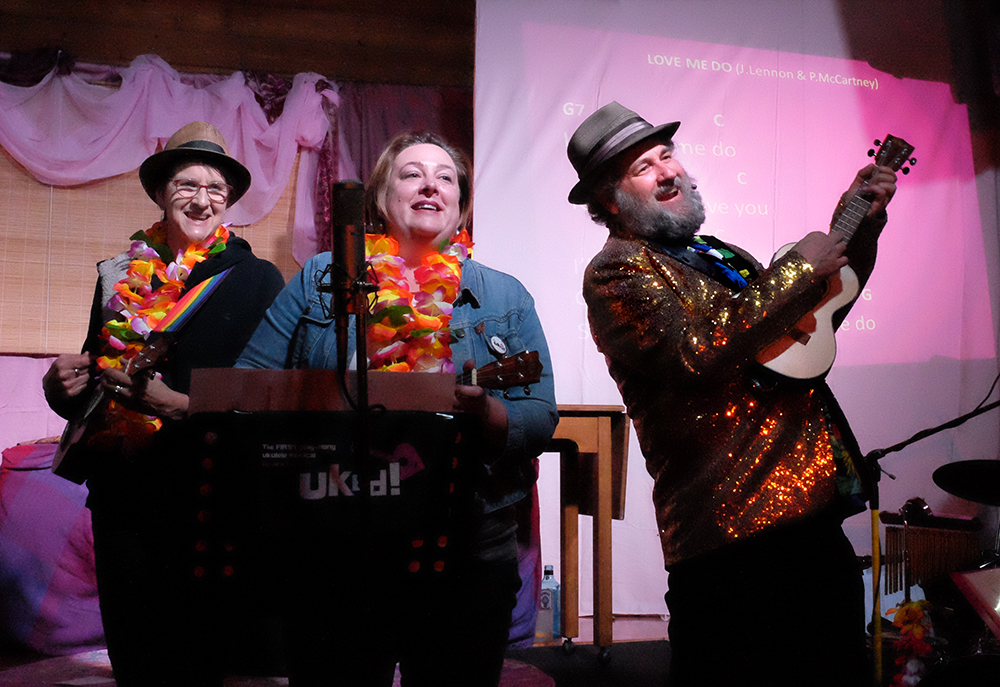
Volunteer Performers playing Karla’s fellow club members from the Newstead Ukulele Troupe (NUTS), on stage with Pete Gavin as JEREMY, the NUTS leader.
Calling all passionate ukulele players! You’re invited to be in the hit play-along ukulele musical, Uked!
THE STORY
Uked! is the hilarious and poignant story of KARLA, who is dumped on her 50th birthday by her violin-playing boyfriend Brian. Between caring her for aged mother and working at Pack’nTrack with her friends Leonie and Julie, Karla begins to worry that she’ll never find love. The world is changing and she’s struggling to find her place in it. Desperate to belong and prove her musical worth, Karla buys a ukulele and joins a dating site – learning that love and the ukulele have a lot in common.
Rebecca Morton who starred as KARLA in the Uked! premiere to sell-out audiences in Guildford Central Victoria in 2029
‘I wrote the show for all the Karlas out there, and to celebrate the humble ukulele’s ability to bring people together – and as an antidote to the daily misery of the news.’ – Jane Cafarella, writer.
MUST SEE! Take your uke, join in, sing or smile along! A GREAT NIGHT! Laughed a lot.‘ – Michelle Robie, Castlemaine, Vic.
‘If you only get to indulge in one ukulele fantasy this year, make sure it’s this one. A great night out!‘ – Kim Burns Music.‘Gave in, going again! 🤣🤣👏🏼👏🏼 please don’t miss this!‘ – Kaye Nankervis, Bendigo.
BE IN THE SHOW
Bring your uke and play-along with Karla from the audience (chords and lyrics displayed on screen). Playing level: beginner to intermediate. Songbook provided in advance.
BE ON STAGE WITH KARLA
Be on stage as KARLA’S fellow ukulele club members. Four Volunteer Performers are required each night. VPs get discounted tickets, free merch and attend two rehearsals.
Hate audience participation? Just sit back and enjoy the show!
NUTS in action on stage with KARLA (Rebecca Morton) and JEREMY (Pete Gavin) in the Guildford premiere of Uked!
NUTS in action at the Newham Mechanics Institute with KARLA (Rebecca Morton) and JEREMY (Pete Gavin).
KARLA (Rebecca Morton) gets into the song with the GRUBS (Guildford Regional Ukulele Band) led by RUTH (Fi Chant – far right).
BE IN THE UKED! BAND
Professional players and seasoned ukulele teachers are invited to register their interest to audition for the Uked! band. Two players are required (bass and tenor). Includes a small walk-on acting role.
JEREMY (Pete Gavin) and JOEL (Tex Turkey – drummer in the Uked! band) ham it up while KARLA (Rebecca Morton) and the NUTS play along.
SPONSOR OUR SHOW!
We’re looking for cash sponsorship and opportunities to partner with relevant companies. We offer high visibility and unique audience engagement for those whose products are ukulele or music-related, or whose products are of interest to older people who are looking to maximise their enjoyment for life, particularly women. Register your interest at uked.beintheshow@gmail.com.
This brings the total number of FREE comedic and dramatic monologues on this site up to almost 100.
Since I made my monologues and short plays available on this site for free just over three years ago in October 2022, they have been performed in more than 170 locations around the world.
You have a plethora of wonderful, magical and insightful monologues for women. I felt like a kid in a candy shop when I started reading them! – Theresa Puskar, Director, using 12 monolgoues for A Stitch in Time, The Theatre of Western Springs, Illinois, USA
Most of the monologues are free-standing. Some are from my two full-length plays, e-baby (about surrogacy) and d-baby about donor conception.
They range in length from one minute to up to four minutes, and cover the emotions, events and experiences in my life as a woman in today’s world, and in those of my friends and the people I interviewed in my career as a journalist. Of course, these have been fictionalised, and names and circumstances have been changed for privacy and anonymity.
Giving voice to women’s experiences
As a 65 year old woman, I feel as though you climbed into my brain and pulled out the words. – Nancy Ferraro, North Palm Beach, Florida, USA, using ‘Grey’ for an acting class.
I write to make sense of the world I live in and to give voice to the experiences of women like you and me, which have been so often dismissed and ignored in the past.
These seven new free monologues are inspired by my own experiences, those of my friends, and items in the news.
Seeking engagement
I am so grateful for your writing and offerings of so many terrific monologues for a woman actor at the vintage age of 64. – Laurie Gauger, Chicago, Illinois, USA
I’m not asking for money, although you’re welcome to make a donation. What I’m seeking is engagement, and the satisfaction of knowing that my work resonates with women all over the world, and that we are sharing a common experience.
All I ask for you to let me know which monologues you are using, when and where they will be performed, and send photos and feedback.
I’m not an actor, I don’t give acting advice. You’re welcome to interpret them as you see fit. But if you’d like to know more about the one you choose, I’m happy discuss them.
There’s only thing I have a preference for when it comes to acting. If you are performing a sad monologue, I prefer that you don’t cry, but that you seek to make the audience cry through showing emotion with restraint. But that’s just my preference.
Let me know how you go!
I used Happy Medium and Never– I got the job! Thank you so much for your brilliant writing. – Jo Lane, Oxford, United KingdomWow!
All successful writing for theatre requires two other factors apart from the words – the actor’s interpretation and the audience’s reaction and participation, so it really helps me as a writer to know how you go with your performance, and whether the work resonated with you and your director and audience.
I’m also open to ideas and suggestions if you want something in particular written.
I love to hear from actors, directors, drama teachers and students all over the world and to feel part of the global community for whom story telling through theatre is a passion.
So, please, feel free to contact me.
Break a leg!
Here’s what actors like you are saying:
Thank you so much for allowing me to use this! It’s perfect to showcase my dramatic side. – Anna Hurt, Middleton, Idaho, USA
I am a huge fan of your work and I pray that you continue writing. – Emma Spurgeon, Wellford, Southern California, USA
I read Confession last night — and my teacher was really impressed. Thank you for sharing your talent. – Anne Brown, Peoria, Illinois, USA.
Thank you so much for making the monologue available! It’s wildly accurate and amusing! – Dory Larson, Tarpon Springs, Florida USA, performing ‘Gone to the Dogs’ monologue.
I did my audition yesterday and I got the part! – Merna Ferris, Alberta, Canada, performing ‘Here Come the Cassseroles’
Thank you so much for allowing the use of your scripts! They are very fun indeed!! – Holly Zeleny, Denver, Colorado, USA
Thank you very much for sharing your work online. I especially like your focus on older actresses. – Kristine Samson, Redding, California, USA
Thank you again for your terrific creative writing! – Kerry McGinnis, Austin, Texas, USA
Thanks for writing for who we really are. – Chris Hicks, director, The Narrators, senior acting group at, Central Florida Community Arts
Your monologue was a hit! I think I got a call back! – Laurie Gauger, Evanston, Chicago, Illinois, USA, performing ‘Here Come the Casseroles!’
The monologue was greatly received, with laughter and gasps. I still think “Snapped” is the perfect audition piece for that play. – Geri Beam, Georgia, USA, auditioning for Arsenic and Old Lace
I got a lead part as a result of the audition! – Lisa Grey, British Columbia, Canada, using ‘Quite a Sensation’ to audition’ for the play Four Old Broads.
I think you speak to every woman-regardless of the actor’s real age. Somehow, you make your pieces ageless, simple and real. – Kathy Blumenfield Los Alto Hills, California, USA
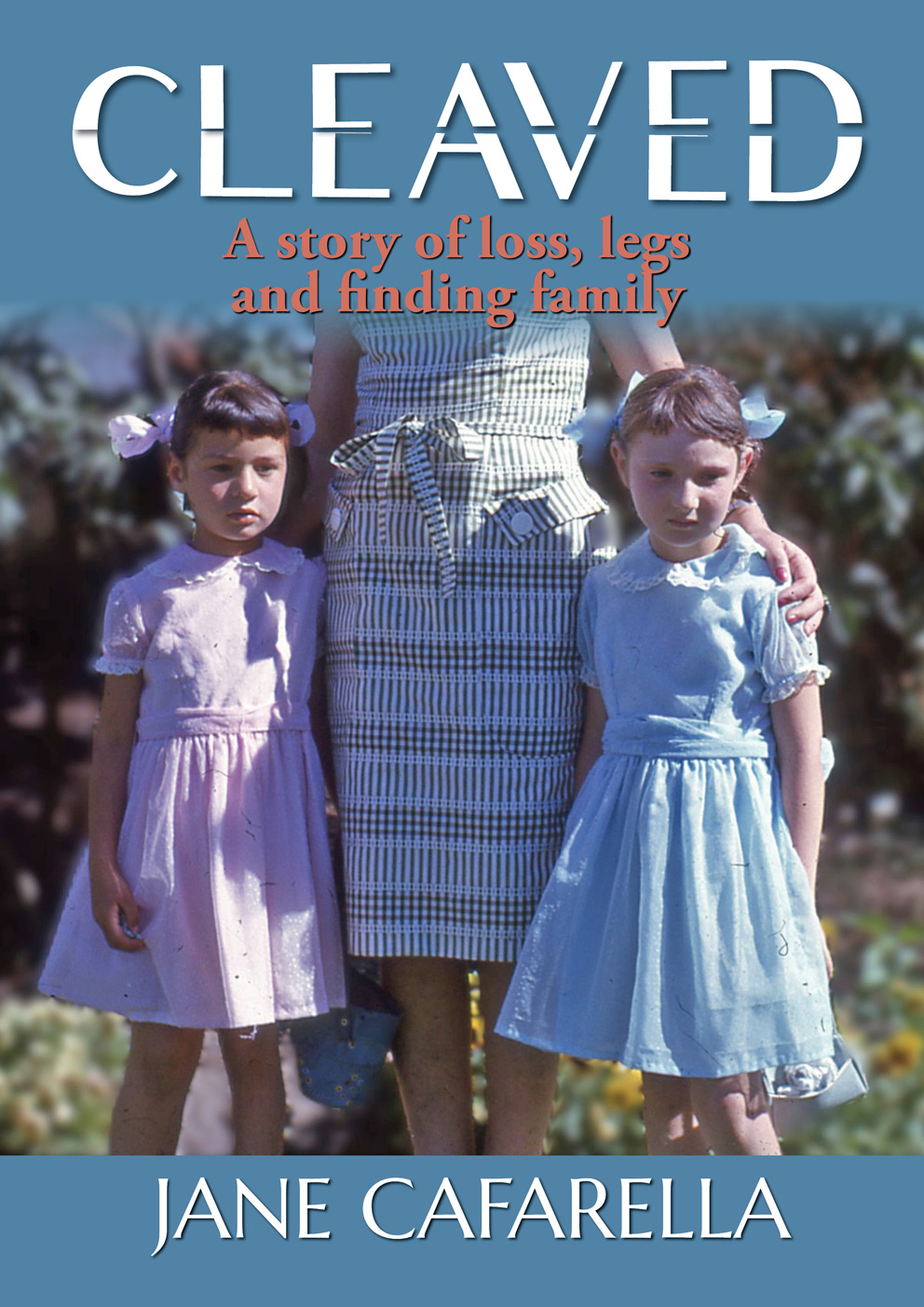
The 60-page guide is an expanded version of a Zoom talk I gave to the Society of Women Writers, on 23 February 2025, based on my experience writing my own memoir, CLEAVED – A story of loss, legs and finding family.
There are many wonderful memoir-writing resources on the internet, but it takes time and energy to find them.
There are also many expert and helpful courses available. This guide is for those who can’t afford them or are still considering whether to invest in one.
The guide includes:
Links to useful resources
Writing tips
Advice on editing and publication’
Fun exercises to get your started
The benefit of learning from an experienced memoir writer
History, as we know, has mostly been written by men, who have made themselves the protagonists of most of the world’s significant events.
Women, if mentioned at all, are minor characters.
Memoir is an opportunity for women to take centre stage: for their voices and stories to be heard at last.
Whether you want to write your story for family and friends, or you plan to pursue publication, writing about your life can be hugely challenging – and immensely satisfying.
However, writing can be a lonely task, and writing memoir can be especially emotionally stressful, so if you do decide to have a go, I highly recommend joining a group of supportive fellow writers, such as those at the Society. https://www.swwvic.org.au/about-us/
The Society recently celebrated its 50th anniversary with the publication of its history, Write On!
If you find this guide, useful, please let me know: jane.cafarella@janecafarella
Watch Toni Brooks, in London, perform Peachy, a 90-second monologue available on this site. Thank you very much Toni, for posting this wonderful performance of Peachy on your Spotlight profile page.
Creativity is alive and well in many places around the world, despite the current political turmoil.
As has happened throughout history, in difficult times, people turn to the arts for solace and inspiration.
As a writer, it’s the way I make sense of the world – which is always much more fun when you are collaborating with fellow artists.
Since I made my short plays and monologues free just over two years ago, I’ve had the privilege of hearing from and working with artists in 130 locations around the world – mostly the USA, UK, Canada, New Zealand and Australia.
I’m especially grateful to all the artists – directors, actors and other creatives – who are currently using my plays and monologues to create their own shows, or for auditions, reels and showcases.
It always amazes me to hear how artists add their skills and ideas to create something special and new – such as the brand new show A Stitch in Time, created by USA director Theresa Puskar for the Theater of Western Springs in Chicago for the Director’s Spring Workshop.
The show will premiere this weekend (28-30 March 2025) at the TWS Cattell Theatre, with shows on Friday and Saturday at 8pm, at 2.30pm and 7.30pm on Sunday.
The show features 12 of my monologues in a show that celebrates the experiences of women at all stages of life.
It’s been very exciting working via Zoom with Theresa, an experienced director, and meeting the talented and dedicated cast.
I’ve produced shows myself, so I know how work and courage goes into them. I’m also very excited to have a show at the Theater of Western Springs, which is highly respected.
At the same time, I’ve been lucky enough to work with Chris Hicks and her enthusiastic team of actors, The Narrators, more than 1000 miles (nearly 2000 km) south of Western Springs, Chicago, at Central Florida Community Arts in Orlando, Florida.
Chris and The Narrators, will also present a new show – On the Fly – Adventures in the Unknown – on April 5 2025, comprising improv/monologues and short plays, featuring five of my monologues, including Flowers, Quite a Sensation, Just a Minute and Taking the Plunge, written especially for this show. Many thanks to Sara Breitfelder for the fabulous photos.
Working with Theresa and Chris has been a highlight of my year so far – along with receiving a video of a beautiful interpretation of my monologue Sweet Bird of Youth from USA actor in Amsterdam Sabrina Culver. (See video below) along with the video (above) from London actress Toni Brooks of her wonderful performance of my monologue Peachy.
It’s been a busy start to the year, with lots of projects, including the 11th production of my most popular 10-minute play Members Only, and the seventh production of my one-act comedy Supersnout.
Here’s the full list of this year’s projects so far:
Current projects
Western Springs, Chicago, The Theatre of Western Springs, presents the premiere of A Stitch in Time, featuring 12 monologues, directed by Theresa Puskar.
Orlando, Florida USA, Central Florida Community Arts, The Narrators present On the Fly – Adventures in the Unknown on April 5 2025, comprising improv/monologues and short plays, and featuring five monologues, including Taking the Plunge, Flowers, Quite a Sensation and Just a Minute – April 5 2025
Bingara, NSW: North West Theatre Company performs Supersnout, a one-act comedy about a talking dog, 19-27 April, Roxy Theatre, Maitland St, Bingara, NSW.
Connecticut, USA: Theatre 308, Darien High School presents Oliver With a Twist, 10-mintue Dickens-inspired sizzling satire about our modern food culture, in May (date TBA). https://www.theatre308.org/aboutus
Salem, Oregon, North Salem High Schoolpresents Members Only, about a woman (recently deceased) who arrives at the Pearly Gates without the password with three performances in April (date TBA).
The photo above is of the performance of Members Only at Virginia Wesleyan University in the USA, directed by Erin Andrews, with Julia Logue playing Karen, Pauly Bolt playing the Concierge, and Lucas Gordon (not pictured) playing Gabriel.
‘Thank you so much for making your work available. It was a gift that kept on giving’ – Erin Andrews.
There are also many actresses currently using individual monologues for auditions, reels and showcases in various locations around the world, including an audition for the London Academy of Music and Dramatic Art (LAMDA).
Amy Martin Cole as the Writer and Jeff Milligan as the Friend in Just a Minute
More than 60 FREE monologues
I hope this will encourage and inspire you to have a rummage through my site.
If you’re an older female actor or a young emerging actor, you’ll find more than 60 contemporary and relevant monologues. If you’re a young theatre major or director, you’ll find lots of short FREE short plays.
Most of the monologues on this site are stand-alone monologues, with a few from my published plays e-baby, d-baby and Uked! The first play along musical, featuring strong roles for women of all ages, with a particular focus on older women.
My aim is to encourage female actors of all ages who are emerging or re-emerging and who want monologues that reflect their own life experiences.
As Chris Hicks said when she first contacted me:
“I am always looking for material that respects our age and experiences. I’m so tired of ‘cute’ plays that take place in nursing homes, featuring at least 10 jokes about incontinence and not driving at night. Thanks for writing for who we really are.”
The monologues are available for use for FREE on the condition that I am credited in full, there are no edits without my permission, and that you email me at jane.cafarella@gmail.com to let me know your location how and when they’ll be used, and provide any photos and feedback about your performance, where possible.
Your feedback helps me to improve my work and lets me know which monologues resonate the most.
To celebrate a great start to the year, here are three new monologues to add to the collection. Please let me know what you think!
While I believe all artists should be paid for their work, I have other work that is licensed with agents and for which I receive royalties, and so can afford to make these shorter works available for free as a service to women just like you.
I’m also available to write something especially for you if you can’t find something here.
I keep a little pinmap to keep track of where my work goes
Thank you everyone for your great response to the two excerpts from my memoir CLEAVED – A story of loss legs and finding family that were published in the Arts section of The Weekend Australian on April 13.
In the past week I’ve been overwhelmed. (Nearly 100 downloads!)
My gratitude to Literary Editor Caroline Overington for giving CLEAVED such a generous run and to readers for their warm responses.
‘I can’t put it down. It’s warm, honest, brilliant…‘ – Jan Harkin, Melbourne
THE STORY
THE STORY
The only family photo of us all together – with, typically, me on the left with Mum, and Juliana with Dad.
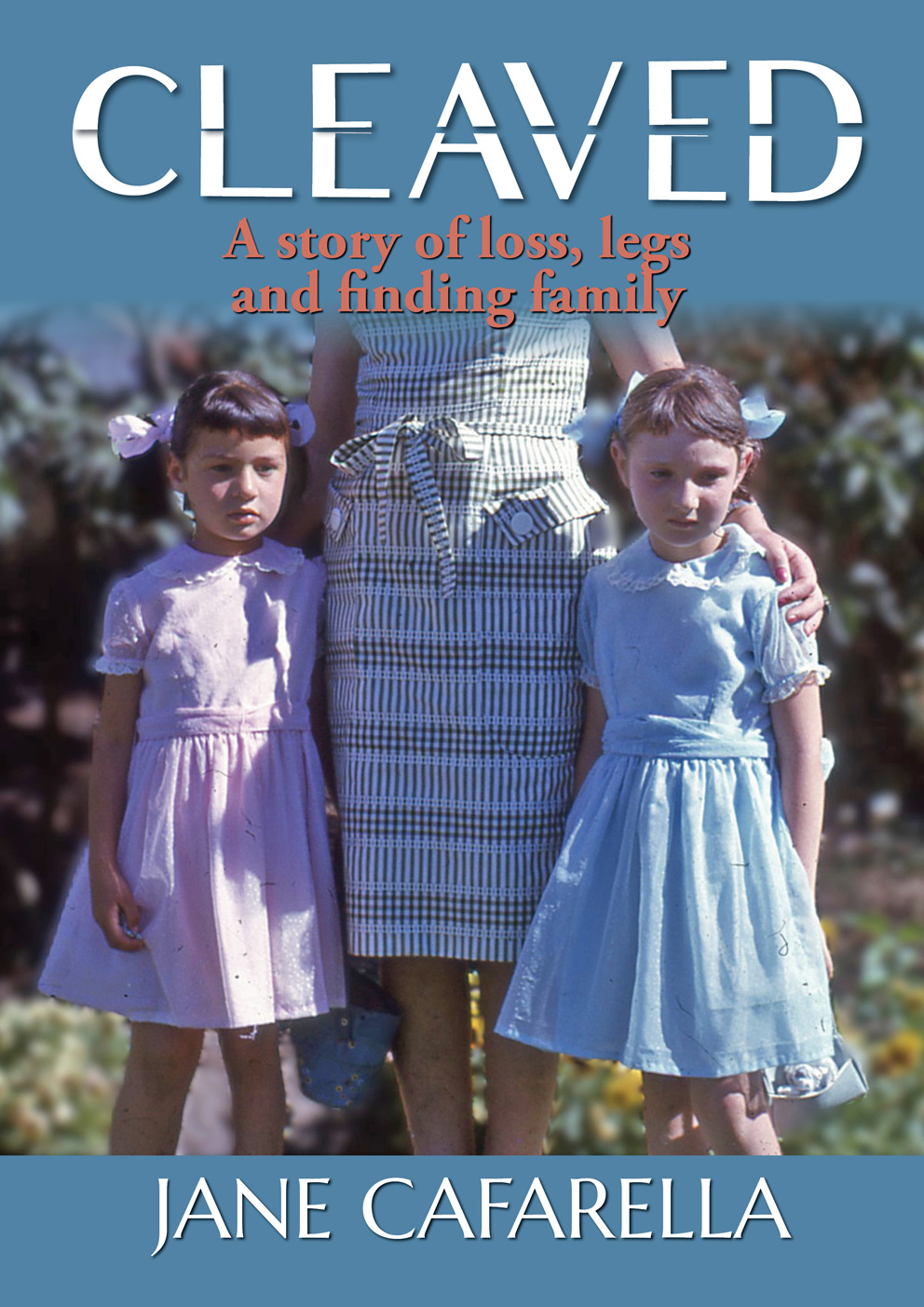
CLEAVED is the story of my sister Juliana and me, foot soldiers in the family war, each cleaved to a different parent from birth – and of the shocking betrayal that blew me and my mother apart from the rest of the family for decades.
It’s also the story resilience, a unique account of growing up with Milroy’s Disease, a rare genetic form of the progressive and incurable swelling disease that meant my right leg was a perfectly proportioned bigger version of my left.
There was no cure and no name for it so it was largely ignored. “Just tell them you were born that way,” my mother said, when I was taunted at school.
My leg problem was always secondary to the bigger family drama of family estrangement. The situation was normal even if I wasn’t.
Cleaved is a coming-of-age story, a story of forgiveness and compassion, both a tragedy and a triumph – and one which reader’s love. Perfect for Book Clubs.
Click the download button above and follow the prompts to pay.
Check your email (and spam) for your receipt.
Click the word “download” on the receipt.
The PDF will appear in your “downloads” file on your computer.
Save it to the file of your choice – e.g. documents. If you leave it in “downloads”, when you open it again, it will regard it as another download and ask you to pay, as there is a download limit of one copy per purchase. If this happens, don’t pay again! Email me at jane.cafarella@gmail.com and I will help you.
REGISTER YOUR INTEREST FOR THE PRINT VERSION
I’ve had some inquiries about a print version, so I’m exploring options for this.
If you are interested in buying a print version of CLEAVED please register your interest by emailing me at jane.cafarella@gmail.com with the word YES in the subject line.
Of course, you’re welcome to comment further in the body of the email if you wish.
What readers like you are sayingabout CLEAVED:
I have just finished reading your book. Beautifully written… I loved the ending. It was a story of forgiveness. Of course I am crying as I write this note. My heart has been deeply touched by your story. –Eileen Dieleson, Perth, Western Australia
I practically inhaled your book – I found it such a fascinating story, beautifully written. Thank you to you and Juliana for sharing so generously and openly. – Jane Haley, Hobart, Tasmania
…I am transfixed. I think it might reach into my heart. I can’t put it down– Marie McNamara, Newstead, Victoria
Fabulous!….Reluctantly putting your book aside to help with dinner – Denise Wheelan, Castlemaine, Victoria
Shamefully, I’ve been lying around all day finishing it, cause I couldn’t put it down. – Suzanne Walshe, Maldon, Victoria
…an incredible story. Beautifully written, … Personally, I found it hard to put down… – Bronnie Dean, Harcourt, Victoria
…a courageous search for a truth that reads like a compelling mystery. – Angela Ryan, South Melbourne, Victoria
Have your read CLEAVED? Would you like to comment? Send your review here jane.cafarella@gmail.com or post on The ABC Facebook Book Club or Goodreads.
Here are some helpful Book Club discussion questions, information and reviews for CLEAVED – A story of loss legs and finding family, a memoir by JANE CAFARELLA
Written with compassion and humour CLEAVED is an illuminating story about losing and finding family and growing up “different”.
Available as PDF on this site or a print version from Amazon and all usual outlets CLEAVED is
A sister story – of two little girls “cleaved” from each other from birth
An immigration story – from the tiny island of Salina, Italy, in the 1920s during the first Italian diaspora
A family estrangement story – a family torn apart by an explosive discovery
A disability story of resilience and acceptance
A story about the healing power of music
A Melbourne story – beginning in 1950s to the present day
A modern tragedy and a triumph
Scroll down for Book Club discussion questions and more information
Here’s what readers like you are saying about CLEAVED
I just finished it. I’m in bits. Such a beautiful story. Forgiveness, the connections, devoid of sentimentality, yet the humanity – the flawed humans – have touched me. Thank you for a great read!
Susie Penrice Tyrie, Singapore
I have just finished reading your book. Beautifully written… I loved the ending. It was a story of forgiveness. Of course I am crying as I write this note. My heart has been deeply touched by your story.
Eileen Dieleson, Perth, Western Australia
I practically inhaled your book – I found it such a fascinating story, beautifully written. Thank you to you and Juliana for sharing so generously and openly.
Jane Haley, Hobart, Tasmania
I am transfixed. I think it might reach into my heart. I can’t put it down.
Marie McNamara, Newstead
Shamefully, I’ve been lying around all day finishing it, cause I couldn’t put it down.
Suzanne Walshe, Maldon
…an incredible story. Beautifully written, … Personally, I found it hard to put down…
Bronnie Dean, Harcourt
…a courageous search for a truth that reads like a compelling mystery.
Angela Ryan, South Melbourne
I cried reading it today. I think it’s just beautiful writing and honesty. It was such a joy to read.
The photo Jane was once so ashamed of: aged 13 in high school. Although she is smiling, she hid the photo in a drawer, where it stayed. Until now.
CLEAVED is the story of Jane and her sister Julie, foot soldiers in the family war, each cleaved to a different parent from birth – and of the shocking betrayal that blows Jane apart from the rest of the family for decades.
It’s also a story of resilience, a unique account of growing up with Milroy’s Disease, a rare genetic form of the progressive and incurable swelling disease lymphoedema – resulting in Jane’s right leg being a perfectly proportioned bigger version of her left.
There’s no cure and no name for it, so it’s largely ignored. “Just tell them you were born that way,” Mum says, when she is taunted at school.
Jane’s leg problem is secondary to the bigger family drama of family estrangement. The situation is normal even if Jane isn’t.
The story begins in 1970s Melbourne, after the family’s emotional cleaving has become physical and Jane and her mother have moved to a small flat – leaving Dad and her rebellious sister Julie in the family home.
It’s 17-year-old Jane’s job to ferry messages between the warring households.
Alone in the flat on a wintery Saturday night, Mum is once again telling Jane how her sister hates her – recounting how Julie severed the top of Jane’s finger when she was a baby.
But Jane isn’t listening. She knows all these stories by heart.
She takes up the story, going back to when the cleaving first begins, and how she becomes Mum’s confidant and Julie’s enemy, and the moment that cleaves Jane from the rest of the family for decades.
Over the years, Jane tries to replace her lost family with serial marriage, while undergoing pioneering surgeries to reduce her expanding leg.
Eventually, she becomes a journalist and cartoonist and creates a perfect family of her own – so perfect she even writes a weekly column about it in Melbourne’s Age newspaper.
But the old family comes back when after 21 years, at Mum’s insistence, Jane reunites with Julie – now Juliana.
“They got the wrong ones. You’re like Dad,” Juliana says when they finally meet.
And so begins the questioning, the unravelling and the comparing of events and stories; of tender and fraught reunions and partings between Jane and her father and sister, until Jane finally puts the pieces of the puzzle together, examining everyone’s part in the family tragedy, including her own.
Cleaved is a coming-of-age story, a story of forgiveness and compassion and the healing power of music – a family tragedy and a triumph, and one which reader’s love.
$1 from every $3.99 purchase goes to the USA-based leading organisation for lymphatic diseases the Lymphatic Education and Research Network (LE&RN). Today 250 million people worldwide suffer from lymphatic disease, which is still widely misunderstood.
HAVING TROUBLE DOWNLOADING? Email me and I’ll sort it promptly! – jane.cafarella@gmail.com.
BOOK CLUB DISCUSSION QUESTIONS
How did you feel when you finished the book?
Did you feel satisfied with the ending?
What did you think of the writing?
Did you relate to Jane as the main character? If so, why?
Discuss the dual meaning of the word Cleaved and how it fits with the book. How does Cleaved explore the theme of estrangement?
Why do you think family was so important to Jane?
Why do you think everyone ignored Jane’s “big leg”. Do you agree with Jane’s conclusion? (p.197)
Do you agree with Juliana when she said, “They got the wrong ones”? (p.126)
How would you describe Jane’s relationship with Mum?
Did you agree with Mum that Jane was “very well adjusted?”
How would you describe Juliana’s relationship with Dad?
Which sister was better off? Jane with Mum or Juliana with Dad?
What did you think about the relationship between the sisters? Did it make your reflect on your own relationships with your siblings?
Do you agree with Dad’s view of forgiveness? (p.188)
Do you agree with Dad’s view of the truth? How does this relate to, or inform, the writing of memoir? (p.182)
Did you know anything about lymphoedema before reading the book? How did the book inform your view of people suffering from deformity?
Discuss the role that music plays throughout the book, and in bringing the sisters together.
In the end, the Jane uncovers some family secrets and finds answers to questions that have haunted her from childhood. Did you relate to this?
What was your favourite scene?
Which part of the story moved you most?
What part was the most surprising?
Which part made you laugh?
Would you recommend this book? If so, to whom?
Contact Jane here (email) if you’d like her to come and speak at your Book Club in person (Melbourne) or via zoom?
Here are 11 NEW monologues for women over 40 to showcase their acting talents
These new monologues are completely FREE – as long as you let me know when, where and how you are using them, so I can keep track of my work. Photos and feedback are also appreciated.
In the past 18 months, my monologues for women over 40 have been performed in many states in the USA, including, Oregon, Wisconsin, Iowa, Virginia, Maryland, New York, Massachusetts, California, Florida and New Jersey, as well as in Toronto and Ontario in Canada, and London and Newhamptonshire in the UK.
My short plays have also been produced by drama teachers and students all over the USA, and in New Zealand and Australia. My one act comedy Supersnout, is currently in production by the Lithgow Theatre Group in South Bowenfels, NSW, for a two-week season in May
Throughout history, it’s common to read about the experiences of men, as leaders and conquerors.
I like to write about the experiences of women – ordinary women and their feelings and personal battles. It’s my way of recording women’s history.
My aim is to give older actresses in particular, material that is strong and relatable to help showcase their talents in auditions, reels, workshops and performances.
Older women’s lives are so rich with experience that it’s a joy to write about them and for them. I didn’t start writing plays until I was in my 50s, so I understand how exciting and daunting this stage of life can be.
Click on the links below to read and download the monologues.
Let me know what you think by commenting here or emailing me directly at jane.cafarella@gmail.com. I’d love to hear from you!
Do you love memoirs about ordinary women with extraordinary lives?
Are you looking for an inspiring page-turner?
Here’s what women like you are saying about CLEAVED:
… I can’t put it down. It’s warm, honest, brilliant. – Jan Harkin, Melbourne, Victoria
Honestly you’ve touched every emotion and feeling in my heart. – Magdalini Lazarro, Melbourne, Victoria
I can’t put into words how much I enjoyed your book! – Sheralyn Iljcesen, , South Australia.
‘I just finished it. I’m in bits. Such a beautiful story. – Susie Penrice Tyrie, Singapore
My heart has been deeply touched by your story. –Eileen Dielesen, Perth, Western Australia
I practically inhaled your book – I found it such a fascinating story, beautifully written. – Jane Haley, Hobart, Tasmania
Shamefully, I’ve been lying around all day finishing it, cause I couldn’t put it down. – Suzanne Walshe, Maldon, Victoria
I am still ‘in the movie’ of your book in my head…It was transformative – Katherine Seppings, Harcourt, Victoria
…an incredible story. Beautifully written, … Personally, I found it hard to put down… – Bronnie Dean, Harcourt, Victoria.
I devoured CLEAVED last Thursday night and was totally engrossed by your story. –Theresa Dickinsen , Canberra.
THE STORY
The story of two sisters who were lost and then found, CLEAVED is the page-turning, funny and tragic memoir of Australian playwright and journalist JANE CAFARELLA.
Raised under the same roof, each allied to a different parent, Jane and her older sister Julie are foot soldiers in their parents’ marital war. Jane is Mum’s. Julie is Dad’s.
The situation is normal, even if Jane’s not. ‘Just tell them you were born that way,’ her mother says when she’s taunted at school for having one fat and one skinny leg.
There’s no name for it and no cure, so it’s ignored, subsumed by bigger family problems.
The emotional cleaving becomes physical when their parents finally separate when Jane is 17 and Julie is 18.
Six months later, an explosive discovery blows Jane and her mother away from the whole extended family forever.
CLEAVED is both a mystery and a search for truth: a sister story, a women’s story, an immigration story, and story of resilience, forgiveness and compassion, told by a master storyteller.
Me at age 13 in high school. This was the last photo I allowed that showed my leg. I soon learned to sit at the back. Later, as it worsened, I wore long dresses or flares to hide it.
*Jane’s ‘big leg’ as her mother called it, was later diagnosed as Milroy’s Disease, a rare form of congenital lymphoedema. In her 20s, she underwent a series of reduction operations with world-renowned micro surgeon Bernard O’Brien for whom the O’Brien Foundation in Melbourne is named. https://www.obrienfoundation.com/history/
$2 from every purchase of the print version of CLEAVED and $1 from every purchase of the e-book is donated to the leading global organisation for lymphatic research and education, the USA-based Lymphatic Education & Research Network (LE&RN)Lymphatic Education and Research Network,
HERE’S WHAT FELLOW AUTHORS ARE SAYING:
An extraordinary story, vividly told – Angela Savage
Candid and compelling – Hazel Edwards
PURCHASE CLEAVED HERE FOR THE SPECIAL CHRISTMAS PRICE OF $30 including postage for the paperback version. OFFER ENDS DECEMBER 15 (to allow time for delivery.) BRADLEY – CAN YOU CREATE A FORM AND BUTTON FOR THIS?
OR
DOWNLOAD the e-book here for $3.99
The World Health Organization estimates that up to 250 million people worldwide live with the incurable, disfiguring, progressive, and little-known disease called lymphedema. In Jane Cafarella’s new memoir, CLEAVED, the veil of secrecy surrounding lymphedema is stripped away as we meet a young girl in Australia living with an undiagnosed deformity. Ms. Cafarella weaves a stirring and universal coming-of-age story where the audience gets a rare glimpse of the impact of living with a disability while traversing the many roads on life’s journey.
William Repicci, CEO of the Lymphatic Education and Research Network (USA), the leading global organisation for lymphatic research and advocacy..
Click the download button above and follow the prompts to pay.
Check your email (and spam) for your receipt. Click the word “download” on the receipt.
The PDF will appear in your “downloads” file on your computer.
Save it to the file of your choice – e.g. documents. If you leave it in “downloads”, when you open it again, it will regard it as another download and ask you to pay, as there is a download limit of one copy per purchase. If this happens, don’t pay again! Email me at jane.cafarella@gmail.com and I will help you.
CLEAVED is also available from Amazon and all the usual outlets. If you purchase from there, and enjoyed CLEAVED, please leave a review.
(If you usually come to this website for free theatre monologues, this post may be a surprise. I hope you’ll consider reading my book, which is full of family drama!)
“Can you get me a dog?” my 87-year-old-father asked my sister a few years before he died. He was lonely and a dog seemed like the obvious solution.
“Dad, dogs cost thousands of dollars these days,” she said.
He was incredulous. Come to think of it, so was I.
When I was a kid, dogs were free unless you wanted a pedigree, and mostly you didn’t because someone always had a puppy to give away.
Dogs these days require clothes, prams, seat belts, toys, toilet services, asthma puffers, dental and medical services, health insurance, day care, spa baths, manicures, hair dressers and sometimes even psychologists.
A dog today is a child that never grows up.
It makes me wistful for my own childhood, when dogs weren’t people.
When I was growing up, dogs didn’t own anything, except perhaps a collar.
Even leads weren’t mandatory, as mostly dogs roamed free.
In those days, the whole world was an off-lead park.
In those days, dogs didn’t need health insurance as they rarely went the vet, unless for a distemper shot, or to be spayed or neutered or put down.
Dogs didn’t go the office, the gym, to cafes, restaurants, movies, day care, or attend work Zoom meetings either.
It was accepted that dogs stayed home – either in the backyard in a kennel, or in the laundry with a bowl of water and food. No one had to rush home to keep their dog company.
Dogs, like babies, are consumers now because business preys on the insecurities of the parents of fur babies, just as it preys on the insecurities of the parents of human babies.
So human
Before you start snarling in defence, let it be known that in my adult life, I, too, have owned several dogs who were also (very special) people.
I get it. Dogs are so human – but much easier to love.
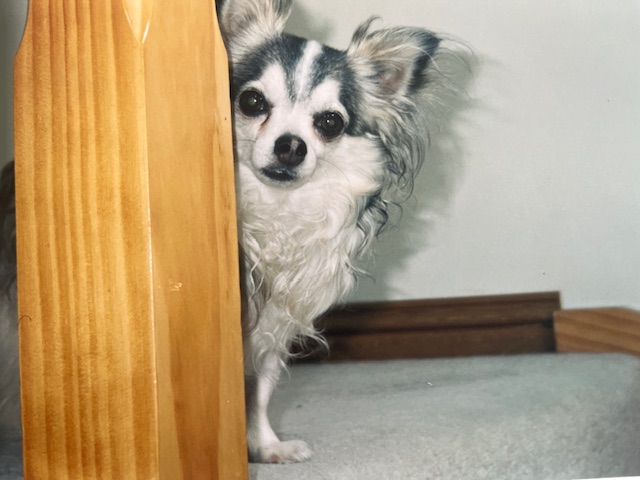
Our long-haired chihuahua, Pepe, pictured above, was so convinced that he was human, he disdained the company of other dogs.
Pepe’s feet seldom touched the ground, as he was mostly worn by me, like a brooch.
When I stopped working from home, I worried he’d be lonely, so I bought him a companion, another long-haired chihuahua named Bambi, whom he hated on sight.
Bambi, where she believed she belonged.
Every time she walked into the room, he walked out. It was like living with a divorced couple.
So popular
Years later, when we lived in Thailand, our tiny brown Chihuahua, Bugsy, was more popular than we were.
“Bugsy!” the local children would cry, as I chugged past with Bugsy suitably restrained in the basket of my step-through Honda 250 motorcycle.
The staff at Starbucks would hand-feed him tasty morsels of scone on a napkin, as he sat royally on the seat opposite me while we waited for my daughter to join us after school.
“Where Buggy today?”, they’d ask, if I dared to leave him at home.
Bugsy had a comfy bed in every room of our house in Bangkok, along with a bowl of water and snacks. He never roamed alone, in case someone stepped on him.
Bugsy – Starbucks favourite customer.
By contrast, Minnie, the little black and white terrier-like bitza we owned when I was a teenager, wore a collar, but seldom a lead.
She followed me to the milk bar where I worked after school, and waited for me outside.
So delighted
If she got sick of waiting, she went home.
At home, Minnie ate table scraps topped up with a bit of Pal (the most popular brand of tinned dog food at the time), served on a sheet of newspaper that was folded up and put in the bin when she finished. (No ant-ridden, sticky bowl to wash.)
Her favourite meal was my mother’s left-over spaghetti bolognese. This delighted her so much that her right back leg would slowly elevate, as if being cranked up, as she quivered in gastronomical ecstasy.
The notion that she might keel over from eating the onion in the spaghetti sauce never occurred to us. (She never did).
Nor did it occur to us that she needed a special bed. Minnie’s bed was an cardboard box from the local green grocer, lined with an old woollen jumper that my sister or I had outgrown .
“In the box!” we’d bark, when we wanted her out of the way, and she’d obligingly jump in.
Nor did we have to pick up her poo. This was a lot easier for us, but harder on the environment. Treading in dog poo was a regular childhood hazard.
It’s good that there are no turds on the beach these days (at least canine ones), and dogs deserve to be well cared for.
So nostalgic
But having experienced both types of dog ownership, I’m nostalgic for the days when you didn’t have stand in the street, biodegradable plastic bag in hand, smiling apologetically at passers-by, while your dog painstakingly squeezes a turd from its bottom.
I miss the days when you could give a dog a bone without a consumer warning attached to it.
When you didn’t have to check the dates and times before you took your dog to the beach.
When dogs weren’t desperate for you to take them for a walk, because they either came with you or walked to the beach by themselves.
Dogs in my day always seemed to be going somewhere.
I know that my nostalgia is misplaced. Dog ownership today is a big responsibility and that’s how it should be.
There were consequences for the freedoms dogs had in in my day. They got hit by cars, sometimes had “the mange”, fleas and ticks, and were sometimes abused and neglected.
Sometimes, free-roaming dogs were dangerous and bit people, who then had to have a tetanus injection.
I know that my nostalgia is a hankering for a time when everything was simpler: when there was no social media connecting us to the problems of the world and less was expected of us all in some ways and more in others.
But I confess, I miss the days when dogs were as carefree as their owners.
I no longer own a dog, but I do have a much-loved grand-dog.
Savannah Buys, as the Child, in the Theatre 308 Darien High School production of Oliver With A Twist in Connecticut, USA
“Thank you so much for these plays! I love ‘Oliver With A Twist’, because it is funny, and a clever story.” – Greyson Neumayer, Senior Student, 2025, Alliance Charter Academy, Oregon, USA.
“There were several moments of chuckles, guffaws, and laughs out loud during this witty satire.” – Brian Hobson, Teacher and Theatre Director, Laporte School, Minnesota, USA
“...even with the first cold read, everyone was in fits of laughter.” – Bonnie Schultz, Theatre Players, Sunshine Coast, Australia.
“Happy to report that the production was a complete success!!” – Cassandra Medrano, Theatre 308, Darien High School, Connecticut, USA.
The love of theatre
One of the most rewarding experiences as a playwright is to inspire a love of theatre.
That’s why I’m so delighted that student directors and actors of all ages in the USA and Australia – and even Spain! – are embracing my FREE short pay Oliver With a Twist.
The play, which satirizes modern food culture, has received eight new productions this year (2025) with another two planned for May 2026.
Drama students at high schools in the United States produced and performed in three of this year’s productions.
These were:
Laporte School in Minnesota,
Theatre 308 at Darien High School in Connecticut
Deep Run High School in Richmond, Virginia.
Claire Wood (waiter) Hannah Huang (Guest 1), Natalie Treacy (Guest 2), Bridget Peters (Guest 3), with Director Cassandra Medrano, (second from right) standing in for Lulu Deluca (Guest 4), and Savannah Buys (Child), rehearsing ‘Oliver with A Twist’ at Theatre 308, Darien High School, Connecticut, USA. Photos: Isabella Moss.
In November, Tooleybuc Central School, NSW, Australia and North Fork High School in Hotchkiss, Colorado, USA, will produce the play. And in May next year it will be produced by student directors at Modesto Junior College in Central Valley, California.
Students at Modesta will also try their hands at directing another four of my short plays Errata, Breaking Up Is Hard To Do, Members Only, and Greater Expectations.
Oliver was also produced by the newly minted Sunshine Coast senior drama group, Theatre Players, in August this year at the Noosa Arts Centre, Queensland, Australia. Theatre Players was the inspiration of Sunshine Coast U3A tutor Bonnie Schultz.
And in May next year, the play will be produced by Cloud Nine Theatre Group, a company of British expats in Murcia, Spain.
Oliver With a Twist is the second most popular of my 10 FREE short plays available to actors and directors everywhere.
The play orginally premiered at the Singapore Arts Centre in 2014, produced and directed by Susie Penrice Tyrie.
A further production, also directed by Susie, was performed Singapore’s Goodman Centre in 2019, for Timeless Tales, produced by Dream Catchers and Arc Light Productions.
Another scheduled production for The British Club, as part of a trio of Dickens-inspired plays, titled What the Dickens! ,was sadly cancelled due to unforeseen circumstances.
Rehearsing Oliver With A Twist for the Noosa Arts Centre one-act play festival. the guests, Vicki Jones, Robina Beard, Jackie Fletcher, Patricia Walters, Sharon Thomas play the Guests, while Carol Wexler plays the waiter. Directed by Patrick Phillips.
The play made a comeback in 2023 students at the Alliance Charter Academy in Oregon, USA produced it. And in the past two years, it’s taken off, as my second most popular FREE short play.
My most popular FREE short play is Members Only, with 18 productions in 11 years. These productions were mostly in schools, universities and community theatre in USA, Australia and the UK.
My aim is to provide free accessible contemporary plays that are easy to produce and are guaranteed to provoke debate.
Congratulations to all the the new theatre makers and students who have performed in Oliver!
I hope you are inspired to look at my other plays and monologues and to continue exploring the joy of theatre.
Students at Laporte School, Minnesota, USA, rehearse ‘Oliver With A Twist’
CONDITIONS OF USE: My short plays are available for FREE on the condition that I am fully credited, users let me know when, where and how the work will be used, there are no changes to the text, and that you send photos and feedback. Your location is important, as I keep a little online pin-map to keep track of where my work goes.
This is a service for community and professional theatre makers alike – my way of giving back to those who gave me my start.
What I’m looking for is connection, so please get in touch if you like my work and want to perform it.
I have other work that is licensed for production and for which I get royalties.
But if you feel inclined, I accept donations HERE to help keep this website going.
Knowing and understanding the events that shaped your parents and grandparents lives can be invaluable in helping you understand your own story.
Join me at the Italian Historical Society , 199 Faraday St, Carlton, Victoria, 24 June, 6.30 -8.30pm for a discussion about how researching my family history informed and and enriched my memoir– and how it can do the same for yours.
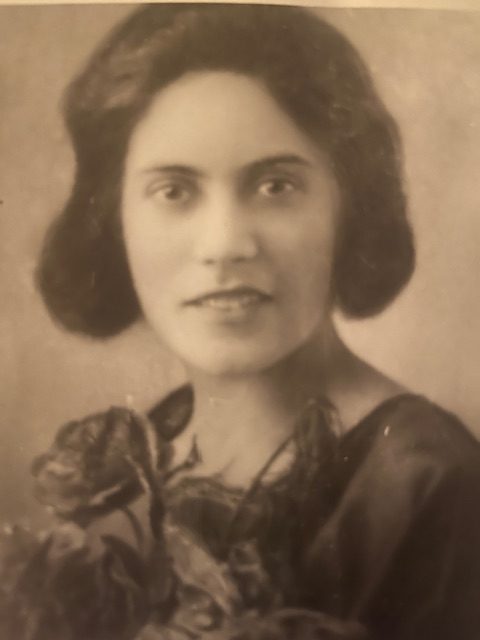
My paternal grandmother, Angelina Taranto, as a young woman. I suspect this formal photo was taken in 1923, just before her 20th birthday, when she and her father migrated to Australia.
‘Cafarella – that’s Italian, isn’t it?
This was the question everyone asked when I told them my name when I was growing up.
‘Yes,’ I’d say. But it felt like a lie
I had the name and the nose and my father’s olive skin, and that’s all.
Unlike my cousins on Dad’s side of the family, my older sister Julie and I didn’t speak or understand dialect. I didn’t even know it was dialect.
Nor were we Catholic. We were raised Anglican, like my mother’s family.
And while our cousins called our Italian grandparents ‘Nonno’ and ‘Nonna’ , to us they were ‘Nana Cafarella’ and ‘Old Cafarella’, as my mother dubbed our grandfather Gaetano.
We spent much more time with our maternal grandmother, who (affectionately) called me ‘Darkie’.
Even our address in Remo St, Mentone, in Victoria, felt like a lie.
Named after Menton, on the French Rivieria, near the Italian border, its founding fathers had named most streets after Italian towns and cities in the hope of creating a similar seaside resort.
‘Married out’
Unlike most Italians, who stuck together, my father had been keen to shed his Italian identity, and so had “married out’, as it was called then. My mother, with her pale freckly skin and green eyes, was of Irish, Scottish and Danish origin
The marriage was a mistake, as she often reminded us.
Although we all lived under the same roof, in the marital war that followed, my father claimed my sister Julie, while my mother claimed me, further aligning me with my mother’s side of the family.
I was 17 when my parents finally divorced, making the emotional separation physical.
Six months later, an explosive discovery blew my mother and me away from the rest of the family for decades. I didn’t see my sister for 20 years and my cousins for 40 years.
I was in my 50s, when I finally learned my family immigration story from his younger sisters Tess and Tina.
I’d heard part of it directly from my grandmother, Angelina, when as a young journalist, I’d interviewed her. But I was young and ignorant then and wasn’t asking the right questions, and her English wasn’t fluent.
Tess and Tina filled in the details.
First Italian diaspora
From them, I learned that Angelina’s father, Francesco Taranto, had migrated to Massachusetts in the USA in 1901, from his home on Salina, the second largest of the Aeolian Islands, off the coast of Sicily, as part of the first Italian diaspora (1901-1915).
There, he’d married the 16-year-old Maria Carmine Favalora, and my grandmother Angelina was born in Boston in 1903.
When Angelina was just 13 months old, Marie Carmine died tragically after a jealous woman cast the Evil Eye (malocchio) on her after hearing her sing at a party.
While Francesco went to Australia to work, Angelina was sent back to Salina to be cared for by an aunt, whom Francesco later married.
Her aunt and then stepmother, Orsola, was of course, wicked, and refused Francesco’s pleas to join him in Australia.
Angelina was almost 20 when it was finally agreed that he should return to Salina to bring her back to Australia to live with him.
New restrictions in the USA on immigrants from Southern Europe had prevented them from returning to Boston. They were also inspired by ‘paesani’ from the village who had migrated to Australia.
Angelina and her father arrived in Sydney on the Orvieto, an English ship, in May 1923.
Gaetano Cafarella, the man she would later marry, arrived three years later in Australia in 1926, after running away from the Gibilmanna Sanctuary in Palermo, where he was training to be a priest.
Still, there were questions. Why, for example, hadn’t Maria Carmine’s family cared for the young Angelina in Boston? Why was she sent back to Italy? And how had Gaetano come to be interned during World War Two?
Keen to find out more, one day in 2016 I walked into the Italian Historical Society in Faraday St, Carlton.
There, unbelievably, with the help of Paolo Baracchi, Manager of Cultural Events, I discovered a translation of an interview with my grandmother Angelina by researcher Marie Tence.
I’d walked past the society the for years, unaware that the answers to many of my questions were awaiting me there.
The document gave my grandmother a voice I didn’t recognise. Here, she was speaking and thinking in her own language, fluent and insightful: not the broken English of my childhood.
St Lorenzo
Until then, I’d had no idea of her life before her arrival in Australia, and how she’d felt later as a wife and mother in a strange land.
I hadn’t known that she had been engaged to another man before she met my grandfather Gaetano – and that neither was her true love. Her father had insisted that she marry Gaetano, as he was from the same village and known to the family.
‘To tell you the truth, I wasn’t really in love with any of them, because I was very much in love with a young man whom I’ll never forget as long as I live, ‘ she told the interviewer. ‘Isn’t it stupid speaking like this at my age – 80 years old, too!’
While my memoir, CLEAVED, is about family estrangement and growing up with Milroy’s Disease, a form of lymphoedema, it’s also an immigrant story, revealing the effect of that immigration on my grandparents and subsequent generations.
Understanding my Italian family’s immigration story, changed my understanding of my own story.
If you live in Melbourne and are interested in family history and memoir writing, you are warmly invited to join me on June 24 at the Society where I’ll be discussing what I discovered from this document, and how this informed my memoir CLEAVED.
My paternal grandmother, Nana Cafarella, (Angelina Taranto) as I knew her, and whose voice spoke to me from the past in a translation of an interview conducted with her in September 1983 by Maria Tence for the Italian Historical Society in Carlton, Victoria.