Why women struggle to say ‘no’

 Saying no can have serious consequences for women – don’t blame us if we struggle

Some years ago, my female friends and I were impressed by the six-year-old granddaughter of  family friend, who when asked to do anything would first consider her options and more often than not, reply simply and politely: ‘No, fanks.’

She became our role model. “No, fanks,” we would laugh, play-acting difficult issues in our own lives, as we chatted over coffee.

But when the play acting stopped, most of us were tongue-tied.

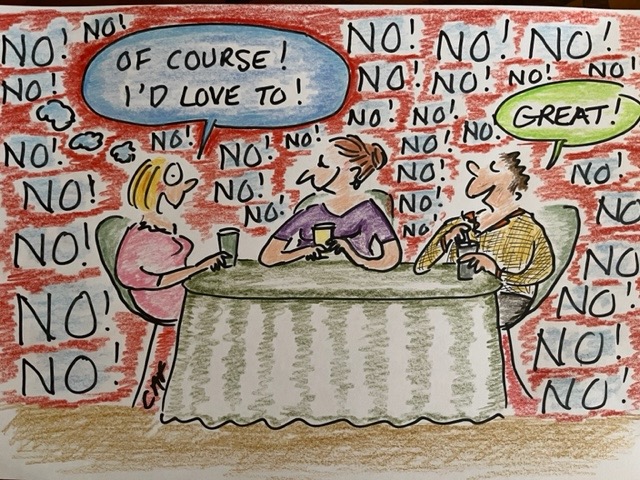
For women of all ages, it’s not the c word that’s forbidden – it’s the n word: NO!

The result, for many, is sticking with a job we hate, a relationship we hate, a life we hate, and sometimes a self we hate.

There are many books and articles about this: about how we smile when we should frown, laugh when we should cry and agree when we should be disagreeable.

Just a few weeks ago, the ABC Radio National program Life Matters ran a segment titled The Cost of Being Good, interviewing Elise Loehnen, author of On Our Best Behaviour – the Price Women Pay to be Good.

The book examines how women strive to be good within the context of the seven deadly sins and how this has coerced us into denying our true selves.

The problem, Leohnen said, was that “women are coded for goodness and men are coded for power”.

“The problem is we’re so scared of conflict. It’s essential that women get in touch with their anger because it shows us what we need and where our needs aren’t being met,” she said.

In her book, she argues for a rebalancing of this expression of needs.

What’s changed? In the 90s, in my role as a journalist, I interviewed authors Claudia Bepko and Jo-Anne Krestan about their similar book, Too Good For Her Own Good – Breaking Free From the Burden of Female Responsibility.

In that book, the authors explored the “women’s code of goodness,” and why, despite all our efforts, we can never feel good enough.

They recommended moving to “a code of balance”, which included a checklist of ways we can change and improve ourselves.

Sigh.

While there are many insightful and useful tips in both books, both ignore one important thing.

It’s not because we are weak, desperate to be liked, programmed for empathy, not assertive enough, or not angry enough that we struggle to say no.

We are not the problem.

It’s because we have learned that saying no can have consequences – serious consequences – for ourselves and those we care about.

In fact and fiction, we are continually warned of these consequences.

The princess in the story of Rumpelstiltskin can’t bring herself  to say, “No fanks!”, when Rumpelstiltskin demands that she spins straw into gold because if she fails to spin, the thing she most loves in the world – her child – will be snatched from her.

It’s a cautionary tale.

In reality, it might even be your own life that will be snatched away, as the statistics about family violence show.  

They also show that women say no all the time on issues of consent – men just have trouble listening.

“Woman was packing her bags to leave abusive relationship before fatal bashing”, said one Guardian headline last week. 

On the same day there was a similar headline in The Age: “ ‘You are evil’ – husband’s despicable murder of childhood sweetheart” – about another woman who paid with her life for trying to leave her violent husband.

Saying no is risky. Being agreeable has always been a survival mechanism for the economically, physically and socially powerless and that is the historical lesson we have learned.  

But perhaps it’s time for some risk assessment?

There are times when we must say yes or die. But there are other times when the death is metaphorical and survivable, if uncomfortable – as I discovered recently when I said no – in roundabout way – to someone who wanted something I couldn’t give.

It wasn’t personal. For health reasons, I just couldn’t manage the task. But as soon as I said it, I wanted to offer an apology.

“Why?” my husband asked. “The person has accepted your decision. End of story. Forget it.”

But I couldn’t. I worried that the other person would think ill of me, and that I had hurt their feelings.

It took a few days, but eventually I accepted my own decision, recognising the risk was low and the reward was high – protecting my health.

I felt better. Freer.

Until a few days later, when I said yes to someone else when I should have said no.

It’s a life-long battle. Perhaps more so for older women like myself who were socialised more traditionally?

But  struggling to say no doesn’t mean we are lacking. It’s simply a sane response to a historic and continuing gender-power imbalance.  

Despite our many gains, as the 2022 UN Women Gender Snapshot shows, there is a disturbing backlash against women’s sexual and reproductive rights and violence against women remains high.

When we struggle to invoke the power of no, we don’t need checklists on how to improve ourselves.

We need courage and support to understand when saying no will risk our life – and when it will save it.

The grief of ageing

Popular debates about identity seldom includes the identity crises of the aged.

Ageing is a popular topic right now. Mostly how not to.  

We marvel (or cringe) as 81-year-old celebrity businesswoman Martha Stewart poses in a swimsuit for Sports Illustrated, and as 85-year-old Jane Fonda stars in her latest movie, dressed as a geriatric Barbie doll.

Meanwhile, back in the real world, my 90-year-old mother-in-law stares into the mirror incredulously and declares loudly, “Ah ya ugly old bat!”

She hasn’t always been so feisty. “No one needs you anymore,” she said quietly, when she was widowed two decades ago.

Managing the ravages of age is the price of a long life.

The other price is loss and grief.

It is indeed a privilege to grow old, to see your children and grandchildren mature, but there is a price for everything, and the often unspoken price of ageing is grief caused by continual loss.

Loss of friends and family through death or misunderstanding, loss of opportunities, loss of health, loss of independence,  loss of memory, loss of relevance, loss of optimism, and loss of confidence in our ability to cope in a changing world.

We grieve for our past lives. We grieve for the dreams and battles of our radical youth – many of which are now being reversed. We grieve for the world we grew up in, as we find ourselves marooned in a different world with a different lexicon, different social mores and different expectations.

We grieve for the fact that the wisdom we have accumulated is not valued. Technology has outrun us and time has consumed us. The world is different, and we have lost our place in it.

Add to this, the issue of money.

What the media doesn’t tell you is that how you feel about growing old depends on how much money you have and how much pain you’re in.

For too many, there is not enough of the former and too much of the latter.

Yet these issues of accumulated grief and loss, this identity crisis, is seldom acknowledged in all the advice about “healthy ageing”, where the focus is mainly diet and exercise.

The popular debate about identity seldom includes the identity crises of the aged.

We barely admit it ourselves, as we sit in cafes, sipping lattes or wine, recounting stories of our travels or showing photos of our grandchildren.

Instead, in search of our lost selves, we gobble up the world, or  return to the dreams of our youth, and take up piano, or gardening or  learn a language, or join a book club – posting our achievements with false humility on Instagram and Facebook while gushing over the achievements of others to prove that we are liked and likable, to prove that we are still here…still worthy…still relevant.

Sometimes this search for our lost selves can make us envious of youth, beauty, confidence and opportunity.

“What do they know of life!” we say, as the newly hatched talk about what is new for them and old for us. And as the words leave our lips we blush, as we hear the echoes of our parents’ voices, shrill with resentment and frustration.

This grief and loss can also make us petty. We grow old but we don’t always grow up. Sometimes, we lash out at those on whom we are dependent, or at those who don’t or can’t give us what we want, which is always, always the same – to  be seen, to be loved, to be valued.

But still, as the days pass, each bringing new losses and new challenges, there are thoughts of what has been, what might have been, and what now will never be: the opportunities that have come and gone, and the people who no longer share our lives.

Ageing may be a time of fulfilment and gratitude, but there is a reckoning as we come to terms with what is, and what can never be again.

Six FREE audition monologues for older women – and four for younger women

Here are six FREE monologues for women over 40 and four for younger women. The monologues range from one minute to four minutes in length.

They may be used by women anywhere, on the condition that you let me know when they are being used and in what context.

I’m always delighted to get any feedback and to hear from actors who are performing them.

Your feedback also helps inform and inspire me about what other topics might be useful for a monologue.

My aim is to fill a gap in the market, providing materials for women who are often under-represented in the theatre – particularly older women.

I also take commissions, so if you are an actor or a theatre company who would like me to write a monologue about a particular topic, please get in touch – jane.cafarella@gmail.com.

Also check out my FREE short plays, suitable for schools, community theatre or professional theatre groups. https://janecafarella.com.au/ten-minute-treats/

I wish you all the best in your acting endeavours and hope you enjoy performing my work. As we say in the Australian theatre scene: “Break a leg!”

Click on the links in the descriptions below to read each monologue.

  1. SNAPPED! (one minute) – ALLIE, 40s -50s, tells a police officer about her passion for photography
  2. THE HOUSE SITTER (two minutes) – LINDA, 40s to 60s, explains to a fellow dog walker, why she can’t accept an invitation for coffee.
  3. A SUNDAY SCHOOL LESSON (two-and-a-half minutes) – RACHEL, 30s-40s, a new Sunday School teacher, tells her pastor about her lesson plan.
  4. SORRY (two minutes) – BARBARA, 30s- 40s, meets an old flame in a busy bar for a drink.
  5. HERE COME THE CASSEROLES (two-and-a-half minutes) – LOUISE, 40s to 60s, tells her friend Karen why she’s fed up with her adoring friends.
  6. QUITE A SENSATION (two minutes) – MARIE, 60-80s, explains to a police officer why she was out at 2am wearing a hoodie and carrying spray paint.
  7. THE TIDY GRAVE (one-and-a-half minutes) – MARY, 40s-80s – talks to her recently deceased husband.
  8. THE BUCKET LIST (three minutes) – HEATHER, 40s-60s, tells her therapist why she’s throwing away her bucket list.
  9. THE MIRROR (one minute) – KATHLEEN, 30s plus, reflects on her own visibility.
  10. MANHOOD (one-and-a-half minutes) – JESSICA, 20s plus, teaches her boyfriend the value of manhood.

ALSO, check out my Free Audition Monologues for Women over 40

These monologues are available for free. This is on the condition that you let me know you are using them, and in what context.

Hungry for more than cooking shows – revisited

This article, published in the Opinion section of The Age on 11 January 2011, was named one of the best articles in Australia by The Week magazine, in its 14 January edition of that year.

The Week is a UK magazine that describes itself as “a new and unique magazine that distils the most important news and comment from the world’s media into an essential weekend read”. An Australian edition was published from 2008-2012.

What’s changed? Do you agree?

HUNGRY FOR MORE THAN COOKING SHOWS

WHEN the ratings period starts again next month and TV programmers serve up a banquet of new cooking shows, spare a thought for the world’s hungry.

There are about a billion undernourished people in the world today, according to the website worldhunger.org, an online publication of the Washington-based private charity World Hunger Education Service.

While you digest that, I can also tell you that there are more than 1.1 billion overweight people and that in America, alone, nearly 70,000 tonnes of food is being wasted each day, while $140 billion is being spent on obesity-related diseases.

More or less. It’s hard to put a final figure on it as stopthehunger.com features all these stats in real time, which means you can watch hunger grow before your very eyes.

Like you, I can do without lashings of guilt to add to the New Year’s diet plan, but today’s national obsession with cooking and eating does seem incongruous when you think that while half the world is cooking or watching cooking shows or reading cookbooks, a significant other part is starving.

It will be interesting to see whether predictions of food shortages and price rises resulting from the devastating Queensland floods will diminish our appetite for this feast of food shows.

While economists are predicting that the food shortages will have only a minor effect on the Australian economy, and that the ensuing rebuilding program will even boost our GDP, people in developing countries, where most of the world’s hungry live, are not so lucky.

As reported in this paper last week, the price of soft commodities such as sugar, grain and oilseed drove world food prices to a record last month, according to a monthly index published by the United Nations.

Increasing demand due to population increases, rising oil prices, a decline in agricultural investment, and the effects of war, drought, flood and earthquakes, have all contributed to the global food security crisis.

But while Rome burns, back in the kitchen we are fiddling around with our food processors.

A report by the Australia Institute in November 2009, titled What a Waste – an analysis of Australian expenditure on food, revealed that “Australians are throwing out more than $5 billion worth of food each year – more than we spend on digital equipment and more than it costs to run the Australian army”.

This is especially sobering when you consider that poor nutrition contributes to half the 10.9 million child deaths in the world each year. Most of these occur in developing countries, but before you dismiss this as “other”, it may surprise you to learn that in Australia, 12 per cent of children live in poverty.

Like most of the people not living in poverty, my resolution for the New Year is to buy less, eat less and give more. Again.

But it’s not just these stark contrasts that bother me. It’s the fact that the national focus is so firmly fixed on our stomachs.

Television is a prime example. It seems that every second show on TV revolves around food. These days, instead of Nana and Mum telling us how to cook, we have Nigella, Jamie, Poh, Hewie, Paul, Luke, Maggie and Simon, Guy, Anthony, Maeve and friends, not to mention George, Matt, Anna and Gary.

Cooking shows have been a staple diet of TV since its invention, but we are now pigging out on them. And we love it. When lawyer Adam Liaw won MasterChef last year, 3.9 million people tuned in.

Who can blame them? Food is irresistible when it’s on your 25-centimetre plate. How much more seductive is it when it’s on a 152-centimetre screen in all its high-definition glory?

Food competition shows are especially tempting: it’s sustenance, it’s entertainment, and it’s drama, with all the thrill of the chase that our hunter and gatherer ancestors knew, without even having to get up from our chairs.

But it’s also a symptom of how self-absorbed and over indulged we are. Cooking may have made us human as Richard Wrangham, professor of biological anthropology at Harvard, says, but a national obsession with cooking and eating is just making us fat and boring.

A friend once prefaced our luncheon meeting with the request that we only spend 10 minutes talking about our health and 10 minutes talking about our children. These days, I would like to add a request that we restrict our conversations about what we ate, or are going to eat, or regret that we ate, to just five minutes.

Perhaps we can spare a few minutes instead on what we can do to help solve the world food crisis? Luckily, there are almost as many hunger sites as cooking shows.

Not only would it make us more interesting, it would help make us part of the solution instead of part of the problem.

What’s your view of cooking shows? Comment or write to me: jane.cafarella@gmail.com

Check out my other Opinion pieces on the toolbar above.

FREE short plays for directors, actors, theatre groups and students

Are you a director, actor, theatre group or student, looking for FREE quality short plays?

Oliver with a Twist, performed at the Goodman Arts Centre, Singapore, as part of Timeless Tales in January 2019.

Here are nine COMPLETELY FREE short plays for you to perform.

They include one-minute, 10-minute, 15-minute and 20-minute plays on a wide range of topical issues, suitable for community theatre groups, schools or individual actors and directors wishing to produce a show or to workshop with students.

I am the author of all the plays and retrain the copyright. The only condition for workshopping or performing the plays is that none of the text is altered, and that you notify me about when and how you are using them – and send photos, please.

All except the one-minute plays have been performed previously, in Australia and Singapore (where I lived for six years), so they’ve been “on their feet”, as we say in the theatre industry, and tested before an audience.

Oliver with a Twist, a comment on our modern food culture, was performed at the Singapore Arts House, directed by Susie Penrice Tyrie in 2014, and in 2019 at the Goodman Arts Centre in Singapore, also directed by Susie Penrice Tyrie, as part of Timeless Tales Family Theatre Fest.

Greater Expectations was also performed at Timeless Tales and Hard Times with the Semi-Naked Chef was performed in Sydney at Script-in-Hand in 2014, directed by Kaye Lopez.

Katherine Shearer as Nigella Awesome and Gabe McCarthy as Oliver Jamie in Hard Times with the Semi-Naked Chef Oliver Jamie, directed by Kaye Lopez at Script in Hand, Sydney, in 2014

Errata was performed in 2013, directed by Chantelle Ashby, by Gemco Players, in Gembrook, Victoria, for its Little Gems 10-minute play festival, and in 2019 by Hobo Players in Castlemaine, directed by Jeffrey Bryant Jones.

She Drinks, a monologue in rhyme about family violence, was performed as part of Rhymes with Silence, a series of short plays about family violence produced by Joy Roberts in Sydney in 2015.

Change Shift, a tribute to Singapore taxi drivers, was performed in Tamil for the Pathey Nimidam 10-minute play festival at the Aliwal Arts Centre in Singapore in 2016, directed by Susan Penrice Tyrie and starring Drake Lim and Varshini Victoria.

In 2020, it was turned into a short film starring Hasisha Nazir as Sonja and Drake Lim as Mr Goh.

For more information about the other plays on offer here, go to my SHORT PLAYS section or follow the links below.

Why am I providing my work for free?

 Because 10 years ago,  I received my start in theatre through the generosity of actors and community theatre groups who took my fledgling plays seriously, so I want to pay it forward.

Because the theatre industry took a huge blow during the pandemic, and this is my way of helping.

And because I’d rather see my work performed than sitting on a shelf or behind a paywall.

I have four published works for which I receive royalties when they are performed: e-baby, d-baby, Supersnout and Uked! – The first play-along ukulele musical, so I do get paid for some of my work.

The joys of short plays

Short plays are a good introduction to theatre for students, who are still learning how to memorise lines and get into character. They are less of a commitment for schools and theatre companies who don’t have the time or resources for a full-length production, and they are good for modern audiences, who are time poor, or who prefer something snappy and fast-paced.

If you read them all, you’ll see some are social comment, while others are just a bit of fun.

Please tell me what you think, what you liked or didn’t like, and where and how you rehearsed and/or performed them.

Nine FREE plays for directors, actors and students

The first three plays may be performed individually or as a trio:

Oliver with a Twist – A Dickens-inspired short play about modern food culture

Greater Expectations – A Dickens-inspired play questioning assumptions about sexual orientation

Hard Times with the Semi-Naked Chef Oliver Jamie – A Dickens-inspired cooking-show spoof

Errata – the true history of Christianity

Members Only – How technology affects us in life – and death.

She Drinks – a monologue in rhyme about family violence

Change Shift – a tribute to Singapore taxi drivers

Quickies: one minute plays for the time-poor

Just a minute – punctuality is key

Altar-ed State – a life-changing walk down the aisle

Commission me to write for you. Want me to write a 10-minute play on a theme of your choice for your theatre group?

Write to me here: jane.cafarella@gmail.com