This brings the total number of FREE comedic and dramatic monologues on this site up to almost 100.
Since I made my monologues and short plays available on this site for free just over three years ago in October 2022, they have been performed in more than 170 locations around the world.
You have a plethora of wonderful, magical and insightful monologues for women. I felt like a kid in a candy shop when I started reading them! – Theresa Puskar, Director, using 12 monolgoues for A Stitch in Time, The Theatre of Western Springs, Illinois, USA
Most of the monologues are free-standing. Some are from my two full-length plays, e-baby (about surrogacy) and d-baby about donor conception.
They range in length from one minute to up to four minutes, and cover the emotions, events and experiences in my life as a woman in today’s world, and in those of my friends and the people I interviewed in my career as a journalist. Of course, these have been fictionalised, and names and circumstances have been changed for privacy and anonymity.
Giving voice to women’s experiences
As a 65 year old woman, I feel as though you climbed into my brain and pulled out the words. – Nancy Ferraro, North Palm Beach, Florida, USA, using ‘Grey’ for an acting class.
I write to make sense of the world I live in and to give voice to the experiences of women like you and me, which have been so often dismissed and ignored in the past.
These seven new free monologues are inspired by my own experiences, those of my friends, and items in the news.
Seeking engagement
I am so grateful for your writing and offerings of so many terrific monologues for a woman actor at the vintage age of 64. – Laurie Gauger, Chicago, Illinois, USA
I’m not asking for money, although you’re welcome to make a donation. What I’m seeking is engagement, and the satisfaction of knowing that my work resonates with women all over the world, and that we are sharing a common experience.
All I ask for you to let me know which monologues you are using, when and where they will be performed, and send photos and feedback.
I’m not an actor, I don’t give acting advice. You’re welcome to interpret them as you see fit. But if you’d like to know more about the one you choose, I’m happy discuss them.
There’s only thing I have a preference for when it comes to acting. If you are performing a sad monologue, I prefer that you don’t cry, but that you seek to make the audience cry through showing emotion with restraint. But that’s just my preference.
Let me know how you go!
I used Happy Medium and Never– I got the job! Thank you so much for your brilliant writing. – Jo Lane, Oxford, United KingdomWow!
All successful writing for theatre requires two other factors apart from the words – the actor’s interpretation and the audience’s reaction and participation, so it really helps me as a writer to know how you go with your performance, and whether the work resonated with you and your director and audience.
I’m also open to ideas and suggestions if you want something in particular written.
I love to hear from actors, directors, drama teachers and students all over the world and to feel part of the global community for whom story telling through theatre is a passion.
So, please, feel free to contact me.
Break a leg!
Here’s what actors like you are saying:
Thank you so much for allowing me to use this! It’s perfect to showcase my dramatic side. – Anna Hurt, Middleton, Idaho, USA
I am a huge fan of your work and I pray that you continue writing. – Emma Spurgeon, Wellford, Southern California, USA
I read Confession last night — and my teacher was really impressed. Thank you for sharing your talent. – Anne Brown, Peoria, Illinois, USA.
Thank you so much for making the monologue available! It’s wildly accurate and amusing! – Dory Larson, Tarpon Springs, Florida USA, performing ‘Gone to the Dogs’ monologue.
I did my audition yesterday and I got the part! – Merna Ferris, Alberta, Canada, performing ‘Here Come the Cassseroles’
Thank you so much for allowing the use of your scripts! They are very fun indeed!! – Holly Zeleny, Denver, Colorado, USA
Thank you very much for sharing your work online. I especially like your focus on older actresses. – Kristine Samson, Redding, California, USA
Thank you again for your terrific creative writing! – Kerry McGinnis, Austin, Texas, USA
Thanks for writing for who we really are. – Chris Hicks, director, The Narrators, senior acting group at, Central Florida Community Arts
Your monologue was a hit! I think I got a call back! – Laurie Gauger, Evanston, Chicago, Illinois, USA, performing ‘Here Come the Casseroles!’
The monologue was greatly received, with laughter and gasps. I still think “Snapped” is the perfect audition piece for that play. – Geri Beam, Georgia, USA, auditioning for Arsenic and Old Lace
I got a lead part as a result of the audition! – Lisa Grey, British Columbia, Canada, using ‘Quite a Sensation’ to audition’ for the play Four Old Broads.
I think you speak to every woman-regardless of the actor’s real age. Somehow, you make your pieces ageless, simple and real. – Kathy Blumenfield Los Alto Hills, California, USA
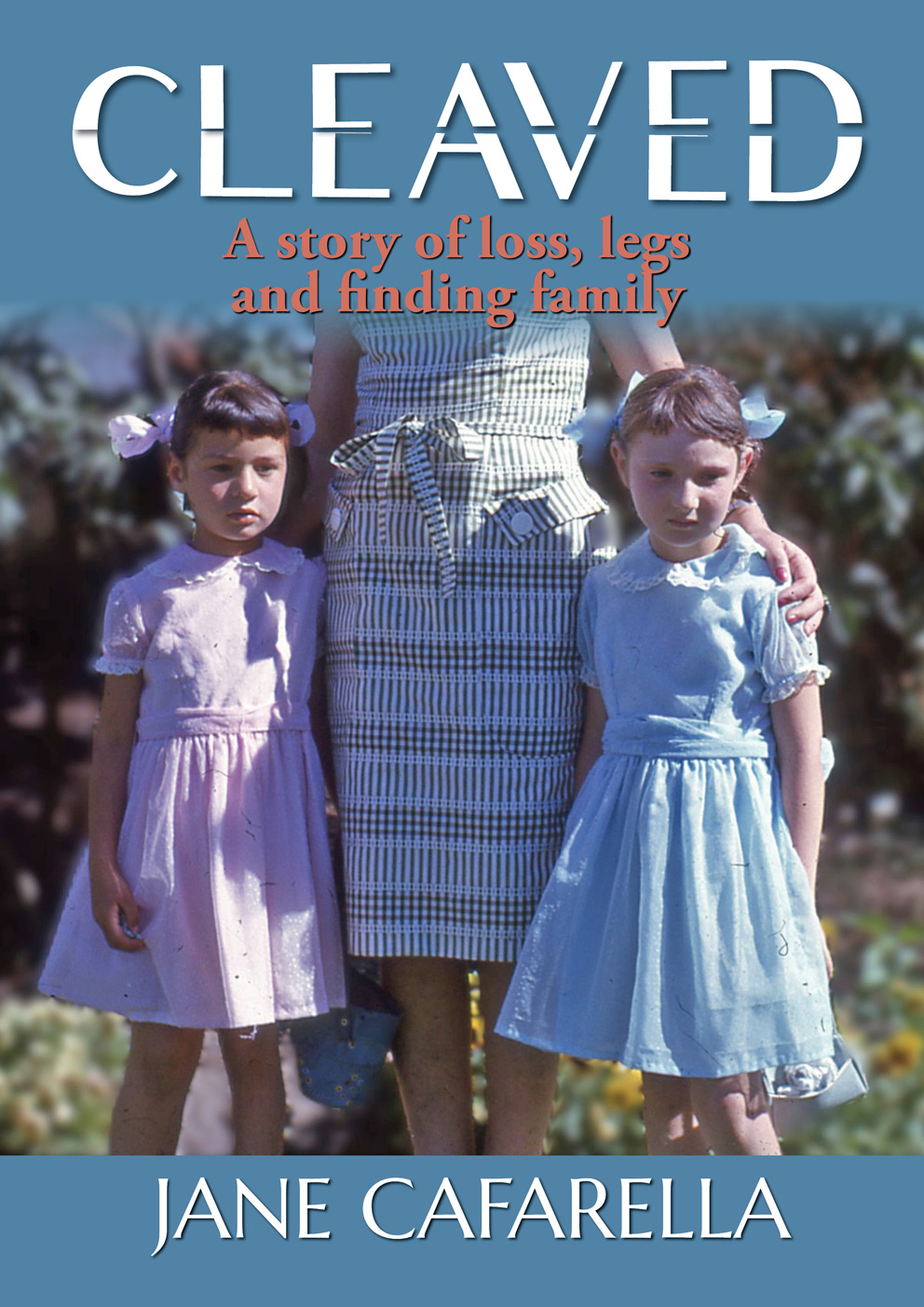
Here are some helpful Book Club discussion questions, information and reviews for CLEAVED – A story of loss legs and finding family, a memoir by JANE CAFARELLA
Written with compassion and humour CLEAVED is an illuminating story about losing and finding family and growing up “different”.
Available as PDF on this site or a print version from Amazon and all usual outlets CLEAVED is
A sister story – of two little girls “cleaved” from each other from birth
An immigration story – from the tiny island of Salina, Italy, in the 1920s during the first Italian diaspora
A family estrangement story – a family torn apart by an explosive discovery
A disability story of resilience and acceptance
A story about the healing power of music
A Melbourne story – beginning in 1950s to the present day
A modern tragedy and a triumph
Scroll down for Book Club discussion questions and more information
Here’s what readers like you are saying about CLEAVED
I just finished it. I’m in bits. Such a beautiful story. Forgiveness, the connections, devoid of sentimentality, yet the humanity – the flawed humans – have touched me. Thank you for a great read!
Susie Penrice Tyrie, Singapore
I have just finished reading your book. Beautifully written… I loved the ending. It was a story of forgiveness. Of course I am crying as I write this note. My heart has been deeply touched by your story.
Eileen Dieleson, Perth, Western Australia
I practically inhaled your book – I found it such a fascinating story, beautifully written. Thank you to you and Juliana for sharing so generously and openly.
Jane Haley, Hobart, Tasmania
I am transfixed. I think it might reach into my heart. I can’t put it down.
Marie McNamara, Newstead
Shamefully, I’ve been lying around all day finishing it, cause I couldn’t put it down.
Suzanne Walshe, Maldon
…an incredible story. Beautifully written, … Personally, I found it hard to put down…
Bronnie Dean, Harcourt
…a courageous search for a truth that reads like a compelling mystery.
Angela Ryan, South Melbourne
I cried reading it today. I think it’s just beautiful writing and honesty. It was such a joy to read.
The photo Jane was once so ashamed of: aged 13 in high school. Although she is smiling, she hid the photo in a drawer, where it stayed. Until now.
CLEAVED is the story of Jane and her sister Julie, foot soldiers in the family war, each cleaved to a different parent from birth – and of the shocking betrayal that blows Jane apart from the rest of the family for decades.
It’s also a story of resilience, a unique account of growing up with Milroy’s Disease, a rare genetic form of the progressive and incurable swelling disease lymphoedema – resulting in Jane’s right leg being a perfectly proportioned bigger version of her left.
There’s no cure and no name for it, so it’s largely ignored. “Just tell them you were born that way,” Mum says, when she is taunted at school.
Jane’s leg problem is secondary to the bigger family drama of family estrangement. The situation is normal even if Jane isn’t.
The story begins in 1970s Melbourne, after the family’s emotional cleaving has become physical and Jane and her mother have moved to a small flat – leaving Dad and her rebellious sister Julie in the family home.
It’s 17-year-old Jane’s job to ferry messages between the warring households.
Alone in the flat on a wintery Saturday night, Mum is once again telling Jane how her sister hates her – recounting how Julie severed the top of Jane’s finger when she was a baby.
But Jane isn’t listening. She knows all these stories by heart.
She takes up the story, going back to when the cleaving first begins, and how she becomes Mum’s confidant and Julie’s enemy, and the moment that cleaves Jane from the rest of the family for decades.
Over the years, Jane tries to replace her lost family with serial marriage, while undergoing pioneering surgeries to reduce her expanding leg.
Eventually, she becomes a journalist and cartoonist and creates a perfect family of her own – so perfect she even writes a weekly column about it in Melbourne’s Age newspaper.
But the old family comes back when after 21 years, at Mum’s insistence, Jane reunites with Julie – now Juliana.
“They got the wrong ones. You’re like Dad,” Juliana says when they finally meet.
And so begins the questioning, the unravelling and the comparing of events and stories; of tender and fraught reunions and partings between Jane and her father and sister, until Jane finally puts the pieces of the puzzle together, examining everyone’s part in the family tragedy, including her own.
Cleaved is a coming-of-age story, a story of forgiveness and compassion and the healing power of music – a family tragedy and a triumph, and one which reader’s love.
$1 from every $3.99 purchase goes to the USA-based leading organisation for lymphatic diseases the Lymphatic Education and Research Network (LE&RN). Today 250 million people worldwide suffer from lymphatic disease, which is still widely misunderstood.
HAVING TROUBLE DOWNLOADING? Email me and I’ll sort it promptly! – jane.cafarella@gmail.com.
BOOK CLUB DISCUSSION QUESTIONS
How did you feel when you finished the book?
Did you feel satisfied with the ending?
What did you think of the writing?
Did you relate to Jane as the main character? If so, why?
Discuss the dual meaning of the word Cleaved and how it fits with the book. How does Cleaved explore the theme of estrangement?
Why do you think family was so important to Jane?
Why do you think everyone ignored Jane’s “big leg”. Do you agree with Jane’s conclusion? (p.197)
Do you agree with Juliana when she said, “They got the wrong ones”? (p.126)
How would you describe Jane’s relationship with Mum?
Did you agree with Mum that Jane was “very well adjusted?”
How would you describe Juliana’s relationship with Dad?
Which sister was better off? Jane with Mum or Juliana with Dad?
What did you think about the relationship between the sisters? Did it make your reflect on your own relationships with your siblings?
Do you agree with Dad’s view of forgiveness? (p.188)
Do you agree with Dad’s view of the truth? How does this relate to, or inform, the writing of memoir? (p.182)
Did you know anything about lymphoedema before reading the book? How did the book inform your view of people suffering from deformity?
Discuss the role that music plays throughout the book, and in bringing the sisters together.
In the end, the Jane uncovers some family secrets and finds answers to questions that have haunted her from childhood. Did you relate to this?
What was your favourite scene?
Which part of the story moved you most?
What part was the most surprising?
Which part made you laugh?
Would you recommend this book? If so, to whom?
Contact Jane here (email) if you’d like her to come and speak at your Book Club in person (Melbourne) or via zoom?
Here are 11 NEW monologues for women over 40 to showcase their acting talents
These new monologues are completely FREE – as long as you let me know when, where and how you are using them, so I can keep track of my work. Photos and feedback are also appreciated.
In the past 18 months, my monologues for women over 40 have been performed in many states in the USA, including, Oregon, Wisconsin, Iowa, Virginia, Maryland, New York, Massachusetts, California, Florida and New Jersey, as well as in Toronto and Ontario in Canada, and London and Newhamptonshire in the UK.
My short plays have also been produced by drama teachers and students all over the USA, and in New Zealand and Australia. My one act comedy Supersnout, is currently in production by the Lithgow Theatre Group in South Bowenfels, NSW, for a two-week season in May
Throughout history, it’s common to read about the experiences of men, as leaders and conquerors.
I like to write about the experiences of women – ordinary women and their feelings and personal battles. It’s my way of recording women’s history.
My aim is to give older actresses in particular, material that is strong and relatable to help showcase their talents in auditions, reels, workshops and performances.
Older women’s lives are so rich with experience that it’s a joy to write about them and for them. I didn’t start writing plays until I was in my 50s, so I understand how exciting and daunting this stage of life can be.
Click on the links below to read and download the monologues.
Let me know what you think by commenting here or emailing me directly at jane.cafarella@gmail.com. I’d love to hear from you!
Do you love memoirs about ordinary women with extraordinary lives?
Are you looking for an inspiring page-turner?
Here’s what women like you are saying about CLEAVED:
… I can’t put it down. It’s warm, honest, brilliant. – Jan Harkin, Melbourne, Victoria
Honestly you’ve touched every emotion and feeling in my heart. – Magdalini Lazarro, Melbourne, Victoria
I can’t put into words how much I enjoyed your book! – Sheralyn Iljcesen, , South Australia.
‘I just finished it. I’m in bits. Such a beautiful story. – Susie Penrice Tyrie, Singapore
My heart has been deeply touched by your story. –Eileen Dielesen, Perth, Western Australia
I practically inhaled your book – I found it such a fascinating story, beautifully written. – Jane Haley, Hobart, Tasmania
Shamefully, I’ve been lying around all day finishing it, cause I couldn’t put it down. – Suzanne Walshe, Maldon, Victoria
I am still ‘in the movie’ of your book in my head…It was transformative – Katherine Seppings, Harcourt, Victoria
…an incredible story. Beautifully written, … Personally, I found it hard to put down… – Bronnie Dean, Harcourt, Victoria.
I devoured CLEAVED last Thursday night and was totally engrossed by your story. –Theresa Dickinsen , Canberra.
THE STORY
The story of two sisters who were lost and then found, CLEAVED is the page-turning, funny and tragic memoir of Australian playwright and journalist JANE CAFARELLA.
Raised under the same roof, each allied to a different parent, Jane and her older sister Julie are foot soldiers in their parents’ marital war. Jane is Mum’s. Julie is Dad’s.
The situation is normal, even if Jane’s not. ‘Just tell them you were born that way,’ her mother says when she’s taunted at school for having one fat and one skinny leg.
There’s no name for it and no cure, so it’s ignored, subsumed by bigger family problems.
The emotional cleaving becomes physical when their parents finally separate when Jane is 17 and Julie is 18.
Six months later, an explosive discovery blows Jane and her mother away from the whole extended family forever.
CLEAVED is both a mystery and a search for truth: a sister story, a women’s story, an immigration story, and story of resilience, forgiveness and compassion, told by a master storyteller.
Me at age 13 in high school. This was the last photo I allowed that showed my leg. I soon learned to sit at the back. Later, as it worsened, I wore long dresses or flares to hide it.
*Jane’s ‘big leg’ as her mother called it, was later diagnosed as Milroy’s Disease, a rare form of congenital lymphoedema. In her 20s, she underwent a series of reduction operations with world-renowned micro surgeon Bernard O’Brien for whom the O’Brien Foundation in Melbourne is named. https://www.obrienfoundation.com/history/
$2 from every purchase of the print version of CLEAVED and $1 from every purchase of the e-book is donated to the leading global organisation for lymphatic research and education, the USA-based Lymphatic Education & Research Network (LE&RN)Lymphatic Education and Research Network,
HERE’S WHAT FELLOW AUTHORS ARE SAYING:
An extraordinary story, vividly told – Angela Savage
Candid and compelling – Hazel Edwards
PURCHASE CLEAVED HERE FOR THE SPECIAL CHRISTMAS PRICE OF $30 including postage for the paperback version. OFFER ENDS DECEMBER 15 (to allow time for delivery.) BRADLEY – CAN YOU CREATE A FORM AND BUTTON FOR THIS?
OR
DOWNLOAD the e-book here for $3.99
The World Health Organization estimates that up to 250 million people worldwide live with the incurable, disfiguring, progressive, and little-known disease called lymphedema. In Jane Cafarella’s new memoir, CLEAVED, the veil of secrecy surrounding lymphedema is stripped away as we meet a young girl in Australia living with an undiagnosed deformity. Ms. Cafarella weaves a stirring and universal coming-of-age story where the audience gets a rare glimpse of the impact of living with a disability while traversing the many roads on life’s journey.
William Repicci, CEO of the Lymphatic Education and Research Network (USA), the leading global organisation for lymphatic research and advocacy..
Click the download button above and follow the prompts to pay.
Check your email (and spam) for your receipt. Click the word “download” on the receipt.
The PDF will appear in your “downloads” file on your computer.
Save it to the file of your choice – e.g. documents. If you leave it in “downloads”, when you open it again, it will regard it as another download and ask you to pay, as there is a download limit of one copy per purchase. If this happens, don’t pay again! Email me at jane.cafarella@gmail.com and I will help you.
CLEAVED is also available from Amazon and all the usual outlets. If you purchase from there, and enjoyed CLEAVED, please leave a review.
(If you usually come to this website for free theatre monologues, this post may be a surprise. I hope you’ll consider reading my book, which is full of family drama!)
This was the question I chose to discuss last month when I had the honour of delivering the keynote speech for the 2023 Nance Donkin Award for Children’s Literature, presented biennially by the Society of Women’s Writers’ Victoria. (Scroll down to read the speech).
Although I am not a children’s author, like Nance Donkin I was a journalist who championed women’s rights, so in many ways I was a kindred spirit.
It was a privilege to hear about the wonderful work of all five nominees, Teena Raffa-Mulligan from Western Australia, Susanne Gervay OAM, from New South Wales, Pamela Rushby from Queensland, Alison Lester from Victoria and Sharon Booth from Tasmania, many of whom were familiar to me from the books I’d read to my own children.
Congratulations to the winner, PAMELA RUSHBY.
Pamela is the author of more than 200 books and has won many awards. Like the stories Nance Donkin, many of Pamela’s stories are inspired by history.
First published in 1877, and still going strong. According to Amazon it sold more than two and a half million copies
Many years ago, while fossicking in a rambling second-hand bookshop in Guildford, near Castlemaine, I came across a children’s book called A Peep Behind the Scenes by Mrs O. F. Walton.
Seeing this book was like greeting an old friend. When I was about 10, my sister and cousin and I spent one particular wet September holiday together, weeping over it.
I immediately bought it to read with my eight-year-old daughter.
A Peep Behind the Scenes is about poor little Rosalie, forced to travel from fair to fair in England with her cruel father and dying mother in a travelling theatre.
One day, a visiting preacher hands her a picture of the Good Shepherd holding a lamb, with the text underneath: “Rejoice with me, for I have found my sheep which was lost. There is joy in the presence of the angels of God over one sinner that Repenteth”.
By the time Rosalie had converted her fifth sinner, my daughter was asking “When are we were going to get the fourth Harry Potter book?”
Despite this, I persevered the next night, but when we came to the sermon about how only the spotlessly white can enter heaven, my daughter said, “This is a load of bull, isn’t?”
I later discovered that the book was first published in 1877 as part of the 19th Century Lamplighter Rare Collectors’ Series – Christian books often given as Sunday School prizes.
The book was said to be an excellent tool for teaching discernment. But it didn’t work for my daughter, as she and her brother are now both in show business.
I make this point because amazingly, A Peep Behind the Scenes is still in print – and is available on Kindle.
It’s been made into a film and there’s a Wikipedia page about it, and another one about the author, Amy Catherine Deck, a preacher’s daughter (1849- 1939) who wrote under her married name of Mrs O. F. Walton and specialised in Christian books.
A Peep Behind the Scenes is also immortalised on Project Gutenberg. Mrs O. F. Walton also has 21 books on Goodreads, with an average rating of 4.19 out of five stars, 1,830 ratings in total, 211 reviews and has been shelved 4,003 times. So far.
“Shelved” means you have added a book to your library by placing it on one of the exclusive shelves on Goodreads, such as, Read, Want to Read or Currently Reading.
Nance Donkin, (1915-2008), who received an Order of Australia in 1986 and this society’s prestigious Alice award in 1990, also has a Wikipedia page and 21 books on Goodreads.
Average rating 3.38 out of five stars, 16 ratings, two reviews – shelved 53 times.
One reason for this disappointing comparison is that the works of Amy Catherine Walton live on, while those of Nance Donkin do not, as all are out of print, although some are available on Amazon second-hand.
It’s easy to assume that works that don’t live on are undeserving – just as it’s easy to assume that work that doesn’t find a publisher is undeserving.
But the questions of whose work lives on and whose gets published are as complex as they are interesting.
On January 5 1951, in her Bookworm Corner column published in The Argus Weekend Magazine, Nance Donkin offered her own definition of a “good children’s book”.
“One of the real tests of a good children’s book, is that adults should be able to read it right through and find it holds their interest,” she said.
If the opinion of Dr John Hughes, retired Senior Lecturer in Education at Deakin University in Melbourne is any indication, Nance Donkin’s books do more than just hold interest.
In his paper titled Convicts and Settlers: Nance Donkin’s Novels of early Sydney and More, published on Academia, Dr Hughes describes Donkin as “a popular and prolific author” in her day, whose work has fallen into “unwarranted neglect”.
To examine why, Hughes analyses the plots and characters of Donkin’s main works, comparing them to her contemporaries and the popular children’s authors who came after her, and concludes:
“Nance Donkin is not a children’s author with the power, or range, for example, of Ivan Southall (arguably Australia’s greatest children’s novelist), or Patricia Wrightson, Morris Gleitzman, Nan Chauncey, Christabel Mattingley, or John Marsden.
“But Donkin presents interesting characters and intriguing narratives, and deserves to be read.”
Hughes suggests a new audience might be found by those interested in our national past.
“Deserves to be read” is an interesting phrase. It implies a right to legacy.
House on the Water (1970) by Nance Donkin drew both praise and criticism, according to Dr John Hughes, who notes that, over all, Donkin’s work has received “very little critical attention”
In Ancient Greece, as exemplified in Homer’s Iliad, legacy is defined as “time”, spelled like our word time – which is honour, and as “kleos”, which is glory.
And, of course, “kudos”, which was the physical manifestation of glory – the prizes and goodies you amass throughout life – such as the Nance Donkin Award for Children’s Literature.
The “time” or honour is the fame we collect during our lifetime and the glory is what we leave so that the “esomino” – those who live after us – are going to know about us, because that is the way we continue to live.
(These days, thanks to social media, the esomino are going know about us whether they like it or not.)
Historically, it’s been much harder for women to achieve this “time”, “kudos” and “kleos” – firstly because historically women were mostly denied education and status – and are still denied these in many countries today.
And secondly because children’s literature has historically been undervalued.
I recently heard a story about a children’s author who was dating a paediatrician.
One day, as they were driving, he turned to her and said, “When are you going to write a book for grown-ups?”
It was at that moment she knew the relationship was doomed.
Later when she thought about it, she regretted not saying “When are you going to start treating grown-ups?”
I don’t think anyone ever said that to Alan Marshall after he wrote I Can Jump Puddles, his childhood memoir, now considered a “Australian Children’s Classic” although he did also write for adults later.
Interestingly, I Can Jump Puddles, first published in 1955, is still in print, published as a Popular Penguin and an audio book.
I Can Jump Puddles, 1955 first edition.And as a Popular Penguin.
My own experience as a reader, suggests the reason for this.
I was 12 when I read I Can Jump Puddles and like Alan Marshall, who was crippled with polio as a child, I had a leg problem.
I was born with Milroy’s Disease, a form of lymphoedema – a progressive swelling disease that meant my right leg was twice the size of my left.
Nothing was known about lymphoedema then, so it was ignored.
Besides, I had other more pressing problems, including petit mal, a form of childhood epilepsy.
Despite this, I was very “well adjusted” – my mother saw to that.
But in Alan’s story, I saw a kindred spirit – someone who understood my daily struggles that were keenly felt but never articulated.
Seeing my interest, my mother encouraged me to write to him and I became one of the many children with whom he corresponded.
When I was 14, I visited him in his home in Eltham and when I eventually became a journalist, I interviewed him several times.
As Philip Nel, the author of Was the Cat in the Hat Black? – The Hidden Racism of Children’s Literature, says “Children’s books shape us more profoundly than almost anything else we read…because we encounter these when we are very much in the process of becoming…”
Children’s books, he says, tell us whose stories matter and whose don’t.
I Can Jump Puddles told me that people like me mattered.
But children don’t get to decide what matters.
Today in the USA, 19 states have banned children’s books that still matter to millions of readers.
Dr Seuss’s picture book Hop on Pop is banned because it encourages disrespect for fathers.
Charlotte’s Webb because talking animals are disrespectful to God.
And Anne Frank’s diary (Diary of a Young Girl) because it’s too sad, although we may guess at the real reasons.
It’s clear that these bans are a battle of ideologies, and have nothing to do with literary merit.
Australia isn’t banning books, but it is changing them – deleting content that’s considered outdated, offensive or inappropriate – and rewriting it in more acceptable language.
In The Guardian (Australia) in February this year, in the debate about Roald Dahl’s books, Rosemary Johnston, Professor of Education at the University of Technology Sydney, noted that racist depictions of Aboriginal people and Chinese and Irish immigrants had been deleted from the Billabong books by Australian author Mary Grant Bruce (1878-1958).
“It’s really nuanced,” she said. “We want that freedom of expression and to maintain the integrity, but we don’t want to publish anything dangerous that would impact a child’s life.”
I wish they’d thought of that when I was 13 and was given a book with a story about a boy called Joseph whose jealous brothers plotted to murder him, and who eventually threw him into a pit to rot.
That story came from The Children’s Bible, the scariest book I ever read.
The Children’s Bible, published by Paul Hamlyn in 1967, the scariest children’s book I ever read, begins with the words, “The Bible tells the story of God’s dealings with men, and the creation of the world.” Not sure what the women were doing.
Don’t get me wrong. My family wasn’t the least bit religious – otherwise they would have known what was in that book.
The trouble with changing books is that the world is constantly changing culturally and socially.
What are we going to do – keep changing every book with outdated and inappropriate language?
The Iliad does not fit with contemporary sensibilities, with its horrifying depictions of battle and its treatment of women as war prizes. But should we rewrite it?
Personally, I think books should be left alone, as cultural and historical icons of their time. Rather than being banned or changed, the should be used for discussion and learning.
There is also an inherent assumption here that children approach books in the same way as adults.
In a discussion on YouTube with Daniel Hahn editor of The Oxford Companion to Children’s Literature, award-winning UK children’s author Gillian Cross says children read in a different way from adults – “a very immersed way”.
Daniel Hahn adds that the books you read as a child “shape your mental furniture in a way that books we read as adults seldom do”.
This point is exemplified in a 2011 Goodreads review of Nance Donkin’s book Johnny Neptune by Australian poet Janelle Bailey.
Bailey writes: “I first read Johnny Neptune as a child, and with it falling into obscurity since, I thought I would never be able to read it again. But thanks to the blessing of an interlibrary loan, I have at last been able to revisit this story after all these years.”
Johnny Neptune, published by Angus and Robertson in 1971.
At first, based on her recollections of reading it as a child, Bailey gave Johny Neptune three-stars.
After rereading it as an adult, she gave it five stars for historical detail and three stars for plot and character, because Johnny was a bit unrealistic.
But, more interestingly, she added:
“I can’t honestly remember what impact these issues had on me when I read this as a ten or eleven year old.
For this reason I would still recommend Johnny Neptune to any young reader who is interested in the history of Colonial Australia.”
In other words, as a child, she didn’t read it with the critical eye of an adult, but in the immersive way that Gillian Cross suggested.
This doesn’t mean that children aren’t discerning.
I was eight when I read The Toy Princess a story by Mary De Morgan in a collection called A Book of Princesses, selected by Sally Patrick Johnson and published by Puffin Books in 1965.
A book I still treasure, given to me by a beloved aunt Francis Boyd, known to the children in our family as “Ga’, and who was a respected history teacher at Fintona Girls School in Melbourne.
I still have this book, and its description on the front page is strangely apt for our times.
It begins, “There is a time to read stories about people like yourself and a time to read about people who are different.”
The Toy Princess is about a princess who is different. Born into a kingdom where it was frowned upon to say anything more than necessary (boiled down to four phrases: “Just so”, “Yes, indeed”, “Thank you” and “If you please”) the joyous and expressive young Princess Ursula is always transgressing.
Eventually, her fairy godmother removes her to the home of a kindly fisherman and his family – leaving a toy princess in her place.
When Ursula turns 18, she is reunited her with her father, the King, only to discover that the he and his subjects prefer the toy princess.
Princess Ursula gladly returns home to the fisherman’s cottage and marries his son, living happily ever after.
I wish Lady Diana Spencer had read this book.
Not surprisingly, the author, Mary De Morgan, was writing in the time of Queen Victoria and the story was a response to the Victorian requirement for extreme politeness.
The message I took from this book was not to be less polite to my parents, as the book banners might fear.
The message I took away was to value freedom over status – especially as a girl – a lesson that has stayed with me.
As you see, legacy isn’t always the result of prizes, although prizes are still very nice.
In closing, I would like to congratulate all nominees for this year’s Nance Donkin Award, for your courage and talent, and remind you that “legacy” – often fickle and elusive – comes from the moment a child picks up your book and finds something that she can use to “furnish her mind”, or perhaps even change her life.