
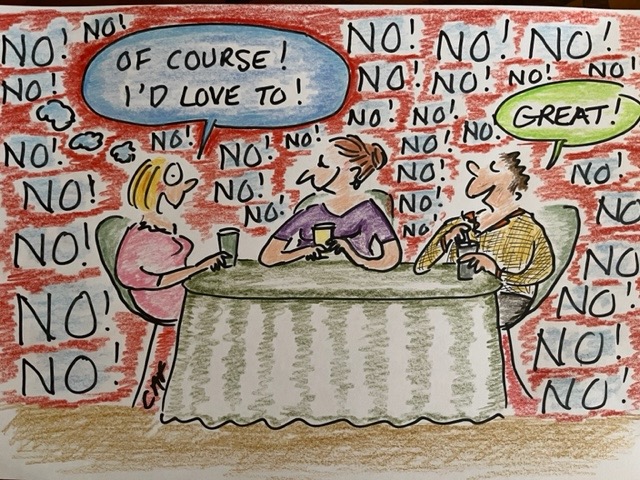
Saying no can have serious consequences for women – don’t blame us if we struggle

Some years ago, my female friends and I were impressed by the six-year-old granddaughter of family friend, who when asked to do anything would first consider her options and more often than not, reply simply and politely: ‘No, fanks.’
She became our role model. “No, fanks,” we would laugh, play-acting difficult issues in our own lives, as we chatted over coffee.
But when the play acting stopped, most of us were tongue-tied.
For women of all ages, it’s not the c word that’s forbidden – it’s the n word: NO!
The result, for many, is sticking with a job we hate, a relationship we hate, a life we hate, and sometimes a self we hate.
There are many books and articles about this: about how we smile when we should frown, laugh when we should cry and agree when we should be disagreeable.
Just a few weeks ago, the ABC Radio National program Life Matters ran a segment titled The Cost of Being Good, interviewing Elise Loehnen, author of On Our Best Behaviour – the Price Women Pay to be Good.
The book examines how women strive to be good within the context of the seven deadly sins and how this has coerced us into denying our true selves.
The problem, Leohnen said, was that “women are coded for goodness and men are coded for power”.
“The problem is we’re so scared of conflict. It’s essential that women get in touch with their anger because it shows us what we need and where our needs aren’t being met,” she said.
In her book, she argues for a rebalancing of this expression of needs.
What’s changed? In the 90s, in my role as a journalist, I interviewed authors Claudia Bepko and Jo-Anne Krestan about their similar book, Too Good For Her Own Good – Breaking Free From the Burden of Female Responsibility.

In that book, the authors explored the “women’s code of goodness,” and why, despite all our efforts, we can never feel good enough.
They recommended moving to “a code of balance”, which included a checklist of ways we can change and improve ourselves.
Sigh.
While there are many insightful and useful tips in both books, both ignore one important thing.
It’s not because we are weak, desperate to be liked, programmed for empathy, not assertive enough, or not angry enough that we struggle to say no.
We are not the problem.
It’s because we have learned that saying no can have consequences – serious consequences – for ourselves and those we care about.
In fact and fiction, we are continually warned of these consequences.
The princess in the story of Rumpelstiltskin can’t bring herself to say, “No fanks!”, when Rumpelstiltskin demands that she spins straw into gold because if she fails to spin, the thing she most loves in the world – her child – will be snatched from her.
It’s a cautionary tale.
In reality, it might even be your own life that will be snatched away, as the statistics about family violence show.
They also show that women say no all the time on issues of consent – men just have trouble listening.
“Woman was packing her bags to leave abusive relationship before fatal bashing”, said one Guardian headline last week.
On the same day there was a similar headline in The Age: “ ‘You are evil’ – husband’s despicable murder of childhood sweetheart” – about another woman who paid with her life for trying to leave her violent husband.
Saying no is risky. Being agreeable has always been a survival mechanism for the economically, physically and socially powerless and that is the historical lesson we have learned.
But perhaps it’s time for some risk assessment?
There are times when we must say yes or die. But there are other times when the death is metaphorical and survivable, if uncomfortable – as I discovered recently when I said no – in roundabout way – to someone who wanted something I couldn’t give.
It wasn’t personal. For health reasons, I just couldn’t manage the task. But as soon as I said it, I wanted to offer an apology.
“Why?” my husband asked. “The person has accepted your decision. End of story. Forget it.”
But I couldn’t. I worried that the other person would think ill of me, and that I had hurt their feelings.
It took a few days, but eventually I accepted my own decision, recognising the risk was low and the reward was high – protecting my health.
I felt better. Freer.
Until a few days later, when I said yes to someone else when I should have said no.
It’s a life-long battle. Perhaps more so for older women like myself who were socialised more traditionally?
But struggling to say no doesn’t mean we are lacking. It’s simply a sane response to a historic and continuing gender-power imbalance.
Despite our many gains, as the 2022 UN Women Gender Snapshot shows, there is a disturbing backlash against women’s sexual and reproductive rights and violence against women remains high.
When we struggle to invoke the power of no, we don’t need checklists on how to improve ourselves.
We need courage and support to understand when saying no will risk our life – and when it will save it.