CLEAVED in The Weekend Australian

The benefits of paying it forward

CLEAVED in The Weekend Australian

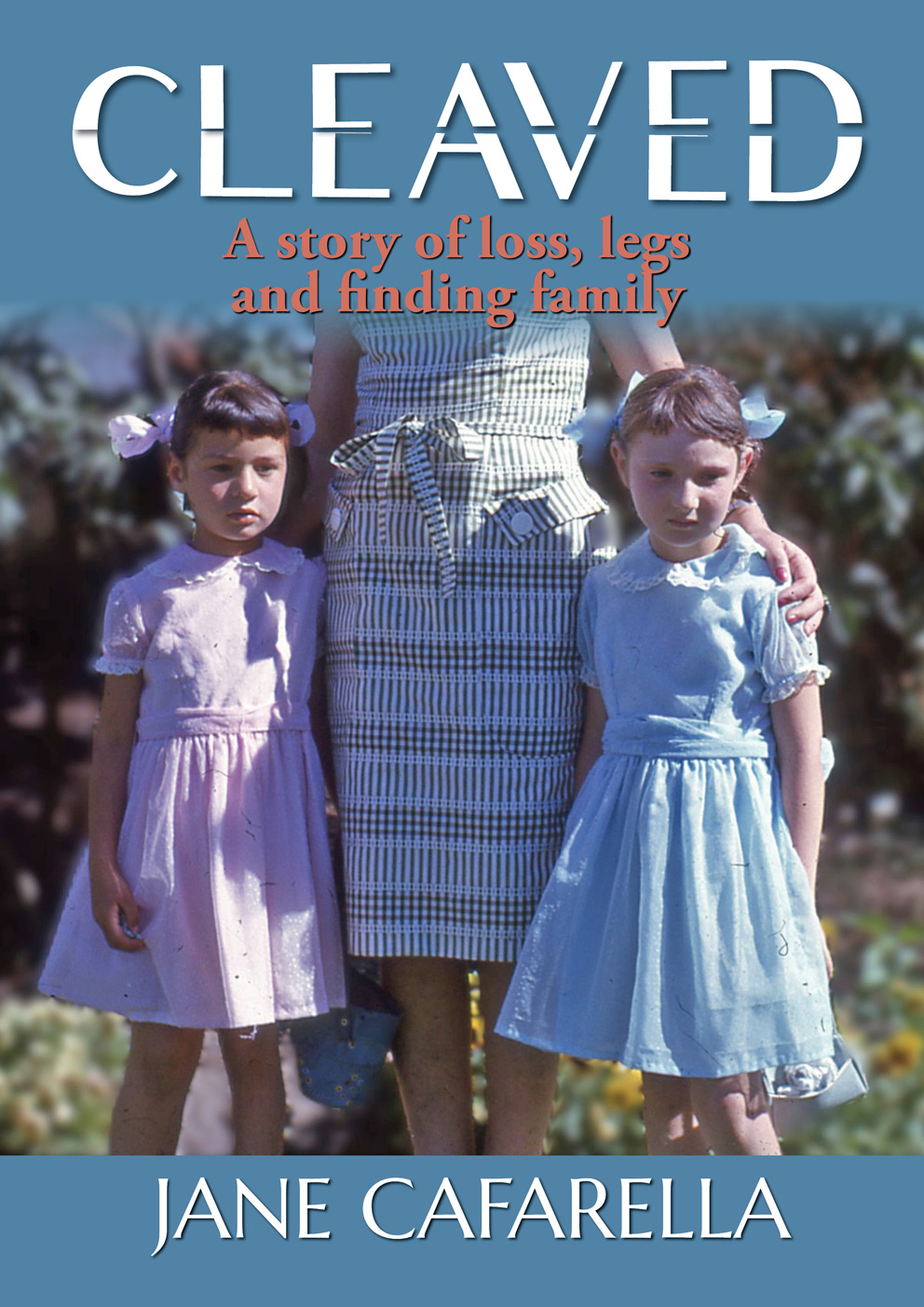
Thank you everyone for your great response to the two excerpts from my memoir CLEAVED – A story of loss legs and finding family that were published in the Arts section of The Weekend Australian on April 13.

 In the past week I’ve been overwhelmed. (Nearly 100 downloads!)

My gratitude to Literary Editor Caroline Overington for giving CLEAVED such a generous run and to readers for their warm responses.

I can’t put it down. It’s warm, honest, brilliant…‘ – Jan Harkin, Melbourne

THE STORY

THE STORY

The only family photo of us all together – with, typically, me on the left with Mum, and Juliana with Dad.

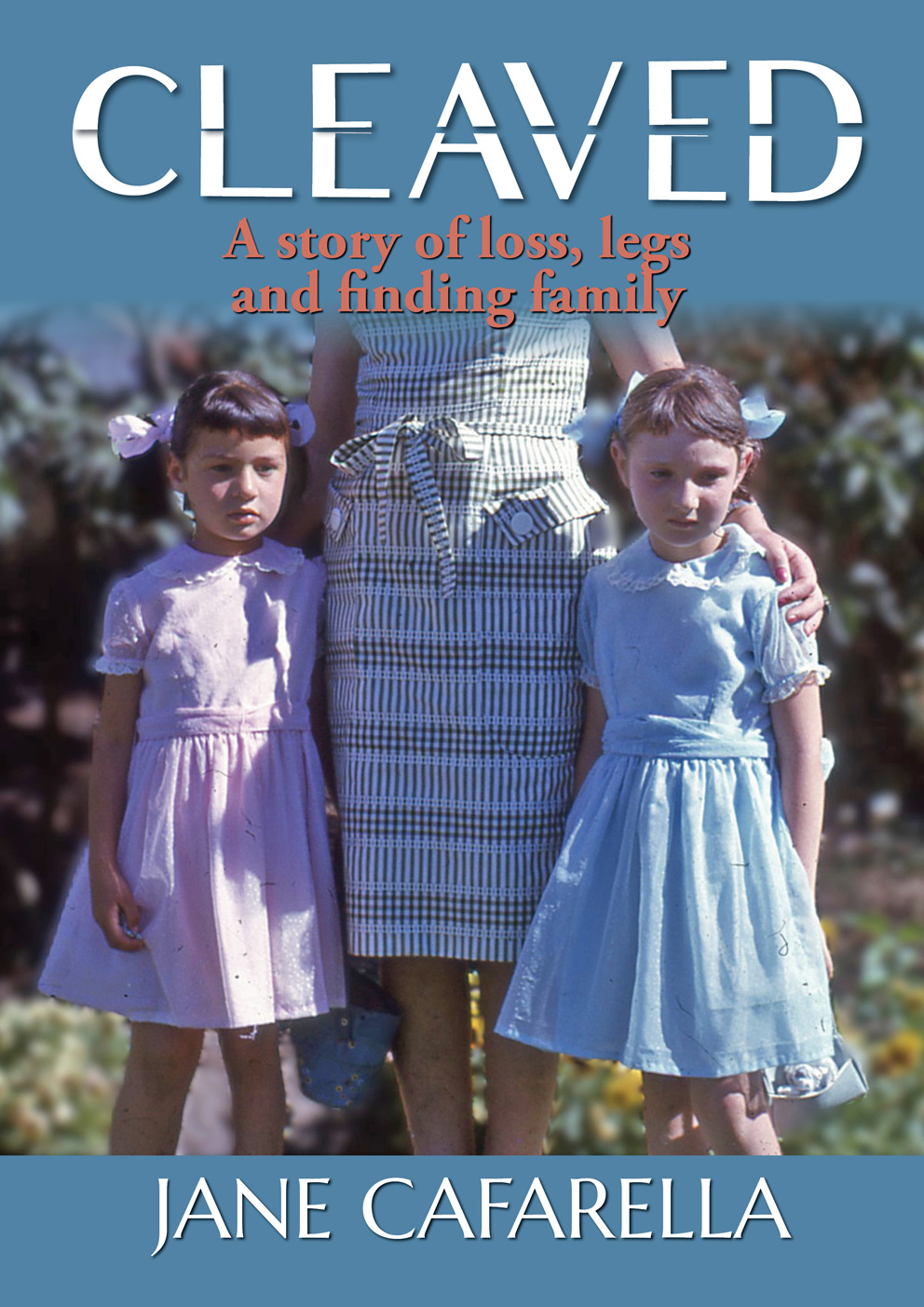
CLEAVED is the story of my sister Juliana and me, foot soldiers in the family war, each cleaved to a different parent from birth – and of the shocking betrayal that blew me and my mother apart from the rest of the family for decades.

It’s also the story resilience, a unique account of growing up with Milroy’s Disease, a rare genetic form of the progressive and incurable swelling disease that meant my right leg was a perfectly proportioned bigger version of my left.

There was no cure and no name for it so it was largely ignored. “Just tell them you were born that way,” my mother said, when I was taunted at school.

My leg problem was always secondary to the bigger family drama of family estrangement. The situation was normal even if I wasn’t.

Cleaved is a coming-of-age story, a story of forgiveness and compassion, both a tragedy and a triumph – and one which reader’s love. Perfect for Book Clubs.

See Book Club discussion questions here:https://janecafarella.com.au/blog/

Cleaved is available as PDF download here:

How to download:

  1. Click the download button above and follow the prompts to pay.
  2. Check your email (and spam) for your receipt.
  3. Click the word “download” on the receipt.
  4. The PDF will appear in your “downloads” file on your computer.
  5. Save it to the file of your choice – e.g. documents. If you leave it in “downloads”, when you open it again, it will regard it as another download and ask you to pay, as there is a download limit of one copy per purchase. If this happens, don’t pay again! Email me at jane.cafarella@gmail.com and I will help you.

REGISTER YOUR INTEREST FOR THE PRINT VERSION

I’ve had some inquiries about a print version, so I’m exploring options for this.

If you are interested in buying a print version of CLEAVED please register your interest by emailing me at jane.cafarella@gmail.com with the word YES in the subject line.

Of course, you’re welcome to comment further in the body of the email if you wish.

What readers like you are saying about CLEAVED:

I have just finished reading your book. Beautifully written… I loved the ending. It was a story of forgiveness. Of course I am crying as I write this note. My heart has been deeply touched by your story.Eileen Dieleson, Perth, Western Australia

I practically inhaled your book – I found it such a fascinating story, beautifully written. Thank you to you and Juliana for sharing so generously and openly. – Jane Haley, Hobart, Tasmania

…I am transfixed. I think it might reach into my heart. I can’t put it down – Marie McNamara, Newstead, Victoria

Fabulous!….Reluctantly putting your book aside to help with dinner – Denise Wheelan, Castlemaine, Victoria

 Shamefully, I’ve been lying around all day finishing it, cause I couldn’t put it down– Suzanne Walshe, Maldon, Victoria

 …an incredible story. Beautifully written, … Personally, I found it hard to put down… – Bronnie Dean, Harcourt, Victoria

…a courageous search for a truth that reads like a compelling mystery. – Angela Ryan, South Melbourne, Victoria

Have your read CLEAVED? Would you like to comment? Send your review here jane.cafarella@gmail.com  or post on The ABC Facebook Book Club or Goodreads.
How making your work free can bring priceless connections

The amazing benefits of paying it forward

The benefits of paying it forward

Dramatic lighting is effective in the final scene of Members Only at Butler University, directed by Hannah Luciani, with Ashley Robbins as the Concierge, Jess Rullo as Karen and Maselli Desantis as Gabriel.

One of the big problems about being a writer is isolation.  Unlike playing music or acting, writing is a solitary activity. 

Even if you work in a café, as I often do, people are cautious about interrupting – or in my case, scared off by my intense look of scowling concentration.

But in the past 18 months,  I’ve unintentionally found one simple solution to writer isolation – making some of my work free.

Since October 2022, when I first took the paywall off my website for my short plays and monologues, my work has been performed in 29 locations around the world – mostly by emerging actors and directors in the USA, the UK, Canada, Ireland and Australia. (I use Pinmaps, an online interactive map service, to keep track of where it all goes.)

The only condition for use is that people let me know when, where and how my work will be used and send photos and feedback.

Members Only, my most popular free short play – about a woman who makes it to the pearly gates, only to find she doesn’t know the password – has been performed in Mt Barker, South Australia, and in the USA in Oregon, Wisconsin, Indiana and Arkansas, with performances in Texas and in the Huon Valley in Hobart, Tasmania next month. 

Members Only has also been submitted for a New Director Workshop, in Virginia (USA) along with three other short plays that are available for free on my website.

What I receive in return is priceless – connection with emerging and established actors, and directors – young and old – all over the world, and the satisfaction that I’m helping other artists grow and learn.

The actors and directors who use my free short plays and monologues mostly aren’t professionals. Mostly, they are female actors who are emerging, or re-emerging, or drama teachers and students.

Hannah Luciana, a junior theatre major at Butler University in Indianapolis, Indiana, who directed Members Only in December 2023 for her final project in her directing class, said: “I loved the humour and characters and felt it would be a great way for me to grow as student learning directing.”

The purpose of the project was to practise casting, learn how to conduct rehearsals, interpret the text and then showcase the work to fellow students and the faculty in a free presentation at the end of the semester.

“In total honesty, directing this show was such a positive and educational experience for me! I loved the comedic aspects, of course, but also loved connecting them with the tangible aspects of religious figures and ideas – it gave the cast and myself material to build from which was great for our short time frame,” Hannah said.

The opening scene of Members Only, produced by Emily Golden at Bismarck High School, Arkansas, showing Karen, arriving at the pearly gates, to find the Concierge, who is the gatekeeper.

Anne Marie Serano, Artistic Director at Acting Out Troupe in Mt Barker, South Australia, was looking for  material for the inaugural performance for a newly formed theatre group, which began with just six “senior ladies who got together and decided they wanted to have fun”.  

They chose Members Only as part of their first show, titled Senior Moments, performed in the Mt Barker library to a sold-out audience last November, followed by an encore performance in December.  

Anne Marie, who has a Masters degrees in Social Work and Drama, said the group would now expand to include general community members “not just older ladies”.

“I was very active in the community theatre in the US. Since coming to Australia  it has taken me 12 years to find my place in an acting/directing capacity. Being a part of the conception and the building of the Acting Out Troupe has been so rewarding. I finally feel totally at home in Australia. The members of this Troupe are warm, friendly and inviting. This has truly been a milestone in my personal and professional life.”

And mine.

When Acting Out Secretary, Pat Pearson, (who played Gabriel in the play), came to visit me in Castlemaine last month, she had a  list of questions about the play, which helped me improve it. (See the tweaked version here, with my other free short plays: https://janecafarella.com.au/ten-minute-plays/)

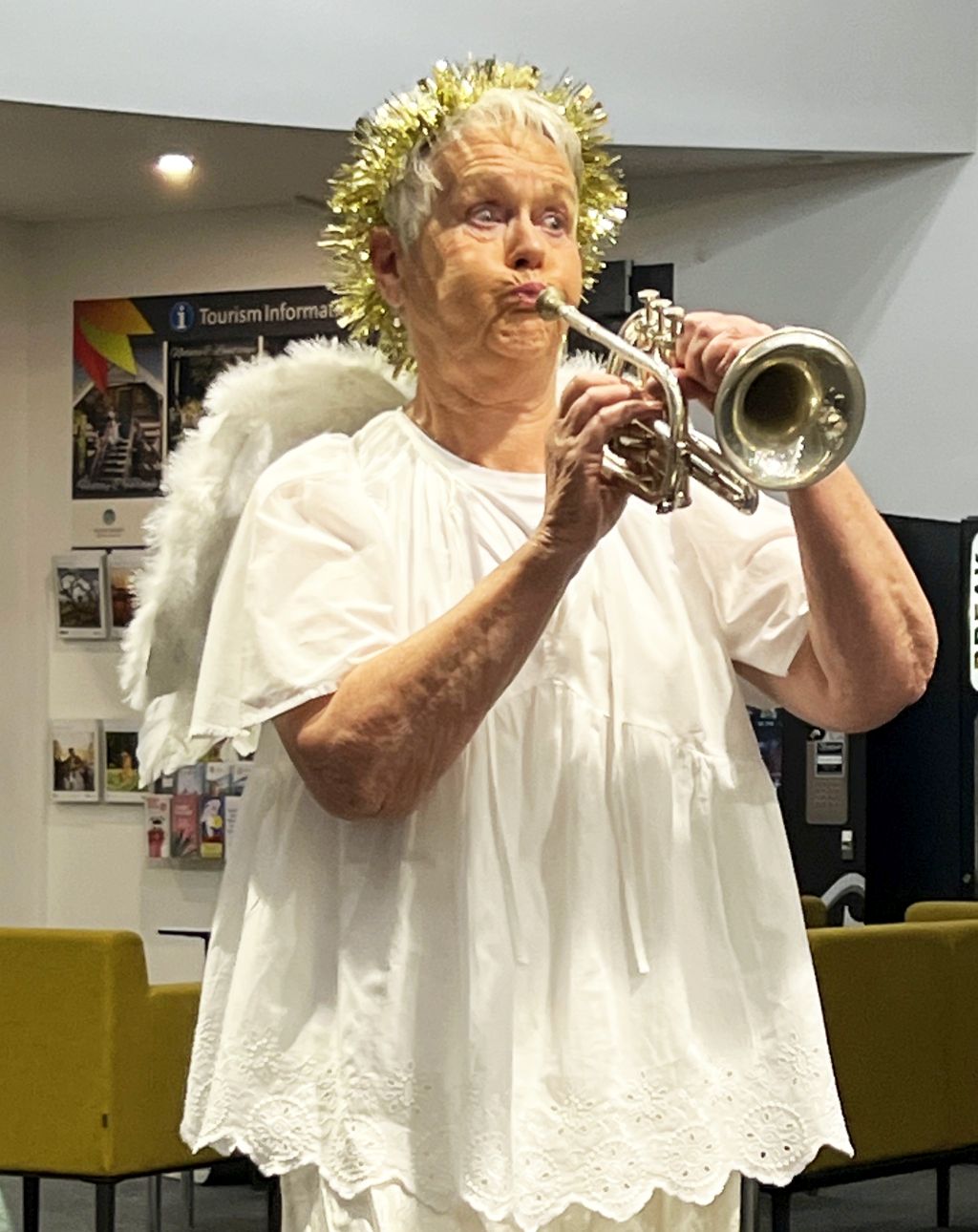
Gabriel, who appears with a trumpet, is the most popular character in Members Only.

Emily Golden, a sponsor of the drama club at Bismarck High School in Arkansas, which produced the play for a short play festival in December 2023, said: “It was an audience favourite, for sure. Everyone loved our Gabriel as well. We had him enter with a trumpet and play terribly, so everyone loved it.”

Here’s a great photo of Pat Pearson as Gabriel, also playing badly, in the Acting Out Troupe debut. (Scroll down for another great interpretation of Gabriel – Maselli Desantis  in the Butler University Production in Arkansas.)

Pat Pearson blows her own trumpet as Gabriel in Acting Out Troupes’ production Senior Moments, in Mt Barker, South Australia, directed by Anne Marie Serano.

I understand the importance of artists being paid for their work. I have two full length plays, a musical and a one act comedy which are licensed with agents, and for which I receive royalties when they are produced.

Uked! –the first play-along ukulele musical, which had two sell-out seasons in Central Victoria, Australia in 2019, will be produced by Libretto Productions in Auckland, New Zealand, in August 2024, and Supersnout, my one-act comedy about a talking dog, will be produced in May by the Lithgow Theatre Company in New South Wales, and by the Kegworth Players in Derby, in the UK.   Supersnout has previously been performed in Melbourne, (Victoria) Toodjay (WA), Aberdeen, (Scotland) and Stratford Upon Avon (UK).

But if, like me, you are in the later part of your career, and you can afford to pay it forward, there are enormous rewards in making some of your work free for those who will benefit.

Acting Out Troupe’s media officer, Lynn Bonython sums it up perfectly: “It’s about connecting with audiences and sharing our human experience.”

Maselli Desantis as Gabriel in the Butler University production of Members Only in Arkansas, USA

Looking for a great BOOK CLUB read?

Here are some helpful Book Club discussion questions, information and reviews for CLEAVED – A story of loss legs and finding family, a memoir by JANE CAFARELLA

Written with compassion and humour  CLEAVED is an illuminating story about losing and finding family and growing up “different”.

Available as PDF on this site or a print version from Amazon and all usual outlets CLEAVED is

  • A sister story – of two little girls “cleaved” from each other from birth
  • An immigration story – from the tiny island of Salina, Italy, in the 1920s during the first Italian diaspora
  • A family estrangement story  – a family torn apart by an explosive discovery
  • A disability story of resilience and acceptance
  • A story about the healing power of music
  • A Melbourne story – beginning in 1950s to the present day
  • A modern tragedy and a triumph

Listen to Jane talking to Hilary Harper for Life Matters:

https://www.abc.net.au/listen/programs/lifematters/i-lost-my-sister-in-my-parent-s-divorce/103878978

Here’s what readers like you are saying about CLEAVED

I just finished it. I’m in bits. Such a beautiful story. Forgiveness, the connections, devoid of sentimentality, yet the humanity – the flawed humans – have touched me. Thank you for a great read!

Susie Penrice Tyrie, Singapore

I have just finished reading your book. Beautifully written… I loved the ending. It was a story of forgiveness. Of course I am crying as I write this note. My heart has been deeply touched by your story.

Eileen Dieleson, Perth, Western Australia

I practically inhaled your book – I found it such a fascinating story, beautifully written. Thank you to you and Juliana for sharing so generously and openly.

Jane Haley, Hobart, Tasmania

 I am transfixed. I think it might reach into my heart. I can’t put it down

Marie McNamara, Newstead

Shamefully, I’ve been lying around all day finishing it, cause I couldn’t put it down.

Suzanne Walshe, Maldon

 …an incredible story. Beautifully written, … Personally, I found it hard to put down…

Bronnie Dean, Harcourt

…a courageous search for a truth that reads like a compelling mystery.

 Angela Ryan, South Melbourne

I cried reading it today. I think it’s just beautiful writing and honesty. It was such a joy to read.

Bradley Dawson, Castlemaine

An intriguing family story – read it in two days.

Susanne Ellis, Occupational Therapist, Hand, Lymphoedema and Wound Clinics, Bendigo Health.

THE STORY

The photo Jane was once so ashamed of: aged 13 in high school. Although she is smiling, she hid the photo in a drawer, where it stayed. Until now.

CLEAVED is the story of Jane and her sister Julie, foot soldiers in the family war, each cleaved to a different parent from birth – and of the shocking betrayal that blows Jane apart from the rest of the family for decades.

It’s also a story of resilience, a unique account of growing up with Milroy’s Disease, a rare genetic form of the progressive and incurable swelling disease lymphoedema – resulting in Jane’s right leg being a perfectly proportioned bigger version of her left.

There’s no cure and no name for it, so it’s largely ignored. “Just tell them you were born that way,” Mum says, when she is taunted at school.

Jane’s leg problem is secondary to the bigger family drama of family estrangement. The situation is normal even if Jane isn’t.

The story begins in 1970s Melbourne, after the family’s emotional cleaving has become physical and Jane and her mother have moved to a small flat – leaving Dad and her rebellious sister Julie in the family home.

It’s 17-year-old Jane’s job to ferry messages between the warring households.

Alone in the flat on a wintery Saturday night, Mum is once again telling Jane how her sister hates her –  recounting how Julie severed the top of Jane’s finger when she was a baby.

But Jane isn’t listening. She knows all these stories by heart.

She takes up the story, going back to when the cleaving first begins, and how she becomes Mum’s confidant and Julie’s enemy, and the moment that cleaves Jane from the rest of the family for decades.

Over the years, Jane tries to replace her lost family with serial marriage, while undergoing pioneering surgeries to reduce her expanding leg. 

Eventually, she becomes a journalist and cartoonist and creates a perfect family of her own – so perfect she even writes a weekly column about it in Melbourne’s Age newspaper.

But the old family comes back when after 21 years, at Mum’s insistence, Jane reunites with Julie – now Juliana.

“They got the wrong ones. You’re like Dad,” Juliana says when they finally meet.

And so begins the questioning, the unravelling and the comparing of events and stories; of tender and fraught reunions and partings between Jane and her father and sister, until Jane finally puts the pieces of the puzzle together, examining everyone’s part in the family tragedy, including her own.

Cleaved is a coming-of-age story, a story of forgiveness and compassion and the healing power of music – a family tragedy and a triumph, and one which reader’s love.

$1 from every $3.99 purchase goes to the  USA-based leading organisation for lymphatic diseases the Lymphatic Education and Research Network (LE&RN). Today 250 million people worldwide suffer from lymphatic disease, which is still widely misunderstood.

HAVING TROUBLE DOWNLOADING? Email me and I’ll sort it promptly! – jane.cafarella@gmail.com.

BOOK CLUB DISCUSSION QUESTIONS

  • How did you feel when you finished the book?
  • Did you feel satisfied with the ending?
  • What did you think of the writing?
  • Did you relate to Jane as the main character? If so, why?
  • Discuss the dual meaning of the word Cleaved and how it fits with the book. How does Cleaved explore the theme of estrangement?
  • Why do you think family was so important to Jane?
  • Why do you think everyone ignored Jane’s “big leg”. Do you agree with Jane’s conclusion? (p.197)
  • Do you agree with Juliana when she said, “They got the wrong ones”? (p.126)
  • How would you describe Jane’s relationship with Mum?
  • Did you agree with Mum that Jane was “very well adjusted?”
  • How would you describe Juliana’s relationship with Dad?
  • Which sister was better off? Jane with Mum or Juliana with Dad?
  • What did you think about the relationship between the sisters? Did it make your reflect on your own relationships with your siblings?
  • Do you agree with Dad’s view of forgiveness? (p.188)
  • Do you agree with Dad’s view of the truth? How does this relate to, or inform, the writing of memoir? (p.182)
  • Did you know anything about lymphoedema before reading the book? How did the book inform your view of people suffering from deformity?
  • Discuss the role that music plays throughout the book, and in bringing the sisters together.
  • In the end, the Jane uncovers some family secrets and finds answers to questions that have haunted her from childhood. Did you relate to this?
  • What was your favourite scene?
  • Which part of the story moved you most?
  • What part was the most surprising?
  • Which part made you laugh?
  • Would you recommend this book? If so, to whom?

Contact Jane here (email) if you’d like her to come and speak at your Book Club in person (Melbourne) or via zoom?

NEW free audition monologues for women over 40

Here are 11 NEW monologues for women over 40 to showcase their acting talents

These new monologues are completely FREE – as long as you let me know when, where and how you are using them, so I can keep track of my work. Photos and feedback are also appreciated.

In the past 18 months, my monologues for women over 40 have been performed in many states in the USA, including, Oregon, Wisconsin, Iowa, Virginia, Maryland, New York, Massachusetts, California, Florida and New Jersey, as well as in Toronto and Ontario in Canada, and London and Newhamptonshire in the UK.

My short plays have also been produced by drama teachers and students all over the USA, and in New Zealand and Australia. My one act comedy Supersnout, is currently in production by the Lithgow Theatre Group in South Bowenfels, NSW, for a two-week season in May

Throughout history, it’s common to read about the experiences of men, as leaders and conquerors.

I like to write about the experiences of women – ordinary women  and their feelings and personal battles. It’s my way of recording women’s history.

My aim is to give older actresses in particular, material that is strong and relatable to help showcase their talents in auditions, reels, workshops and performances.

Older women’s lives are so rich with experience that it’s a joy to write about them and for them. I didn’t start writing plays until I was in my 50s, so I understand how exciting and daunting this stage of life can be.

Click on the links below to read and download the monologues.

Let me know what you think by commenting here or emailing me directly at jane.cafarella@gmail.com. I’d love to hear from you!

VISITING HOURS (DRAMA) – SANDRA, 40+,  is visiting her father in a nursing home

LOSING IT (DRAMA/COMEDY) – LOIS, 60s+ is hunting for her car keys – while defending herself against claims by her son that she is “losing it”.

MOTHER’S DAY (DRAMA) – BRONWYN, 50 +, tells her friend about her Mother’s Day plans – but the voice in her head tells another story.

NEVER (DRAMA) – NINA, 40 +, tells her friend why she has never married

SPECIAL NEEDS (DRAMA/COMEDY) – RUTH 40s+ tells her friend how she learned to finally say ‘NO!”

SPEECHLESS (DRAMA) – ANNETTE, 40+, is talking to her mother.

THE BIRTHDAY (DRAMA) – CECILY, 40+ reminds her husband about an important birthday

THE BREAK-UP (COMEDY) – JOANNE, 40+, tells her book club why she’s leaving

THE GIFT (COMEDY) – WHITNEY, 40s, writes a postcard to her husband Doug on Mother’s Day

THE LESSON (COMEDY) – HAZEL, 40+, tells her local mother’s group about what she’s learned as a mother

Hungry for more than cooking shows – revisited

This article, published in the Opinion section of The Age on 11 January 2011, was named one of the best articles in Australia by The Week magazine, in its 14 January edition of that year.

The Week is a UK magazine that describes itself as “a new and unique magazine that distils the most important news and comment from the world’s media into an essential weekend read”. An Australian edition was published from 2008-2012.

What’s changed? Do you agree?

HUNGRY FOR MORE THAN COOKING SHOWS

WHEN the ratings period starts again next month and TV programmers serve up a banquet of new cooking shows, spare a thought for the world’s hungry.

There are about a billion undernourished people in the world today, according to the website worldhunger.org, an online publication of the Washington-based private charity World Hunger Education Service.

While you digest that, I can also tell you that there are more than 1.1 billion overweight people and that in America, alone, nearly 70,000 tonnes of food is being wasted each day, while $140 billion is being spent on obesity-related diseases.

More or less. It’s hard to put a final figure on it as stopthehunger.com features all these stats in real time, which means you can watch hunger grow before your very eyes.

Like you, I can do without lashings of guilt to add to the New Year’s diet plan, but today’s national obsession with cooking and eating does seem incongruous when you think that while half the world is cooking or watching cooking shows or reading cookbooks, a significant other part is starving.

It will be interesting to see whether predictions of food shortages and price rises resulting from the devastating Queensland floods will diminish our appetite for this feast of food shows.

While economists are predicting that the food shortages will have only a minor effect on the Australian economy, and that the ensuing rebuilding program will even boost our GDP, people in developing countries, where most of the world’s hungry live, are not so lucky.

As reported in this paper last week, the price of soft commodities such as sugar, grain and oilseed drove world food prices to a record last month, according to a monthly index published by the United Nations.

Increasing demand due to population increases, rising oil prices, a decline in agricultural investment, and the effects of war, drought, flood and earthquakes, have all contributed to the global food security crisis.

But while Rome burns, back in the kitchen we are fiddling around with our food processors.

A report by the Australia Institute in November 2009, titled What a Waste – an analysis of Australian expenditure on food, revealed that “Australians are throwing out more than $5 billion worth of food each year – more than we spend on digital equipment and more than it costs to run the Australian army”.

This is especially sobering when you consider that poor nutrition contributes to half the 10.9 million child deaths in the world each year. Most of these occur in developing countries, but before you dismiss this as “other”, it may surprise you to learn that in Australia, 12 per cent of children live in poverty.

Like most of the people not living in poverty, my resolution for the New Year is to buy less, eat less and give more. Again.

But it’s not just these stark contrasts that bother me. It’s the fact that the national focus is so firmly fixed on our stomachs.

Television is a prime example. It seems that every second show on TV revolves around food. These days, instead of Nana and Mum telling us how to cook, we have Nigella, Jamie, Poh, Hewie, Paul, Luke, Maggie and Simon, Guy, Anthony, Maeve and friends, not to mention George, Matt, Anna and Gary.

Cooking shows have been a staple diet of TV since its invention, but we are now pigging out on them. And we love it. When lawyer Adam Liaw won MasterChef last year, 3.9 million people tuned in.

Who can blame them? Food is irresistible when it’s on your 25-centimetre plate. How much more seductive is it when it’s on a 152-centimetre screen in all its high-definition glory?

Food competition shows are especially tempting: it’s sustenance, it’s entertainment, and it’s drama, with all the thrill of the chase that our hunter and gatherer ancestors knew, without even having to get up from our chairs.

But it’s also a symptom of how self-absorbed and over indulged we are. Cooking may have made us human as Richard Wrangham, professor of biological anthropology at Harvard, says, but a national obsession with cooking and eating is just making us fat and boring.

A friend once prefaced our luncheon meeting with the request that we only spend 10 minutes talking about our health and 10 minutes talking about our children. These days, I would like to add a request that we restrict our conversations about what we ate, or are going to eat, or regret that we ate, to just five minutes.

Perhaps we can spare a few minutes instead on what we can do to help solve the world food crisis? Luckily, there are almost as many hunger sites as cooking shows.

Not only would it make us more interesting, it would help make us part of the solution instead of part of the problem.

What’s your view of cooking shows? Comment or write to me: jane.cafarella@gmail.com

Check out my other Opinion pieces on the toolbar above.