
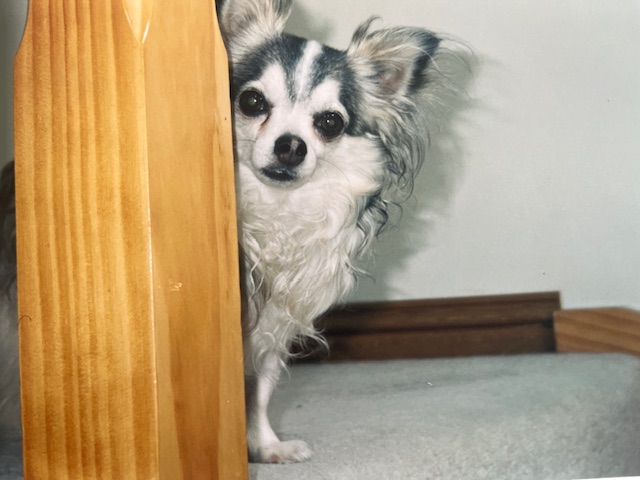

“Can you get me a dog?” my 87-year-old-father asked my sister a few years before he died. He was lonely and a dog seemed like the obvious solution.
“Dad, dogs cost thousands of dollars these days,” she said.
He was incredulous. Come to think of it, so was I.
When I was a kid, dogs were free unless you wanted a pedigree, and mostly you didn’t because someone always had a puppy to give away.
Dogs these days require clothes, prams, seat belts, toys, toilet services, asthma puffers, dental and medical services, health insurance, day care, spa baths, manicures, hair dressers and sometimes even psychologists.
A dog today is a child that never grows up.
It makes me wistful for my own childhood, when dogs weren’t people.
When I was growing up, dogs didn’t own anything, except perhaps a collar.
Even leads weren’t mandatory, as mostly dogs roamed free.
In those days, the whole world was an off-lead park.
In those days, dogs didn’t need health insurance as they rarely went the vet, unless for a distemper shot, or to be spayed or neutered or put down.
Dogs didn’t go the office, the gym, to cafes, restaurants, movies, day care, or attend work Zoom meetings either.
It was accepted that dogs stayed home – either in the backyard in a kennel, or in the laundry with a bowl of water and food. No one had to rush home to keep their dog company.
Dogs, like babies, are consumers now because business preys on the insecurities of the parents of fur babies, just as it preys on the insecurities of the parents of human babies.
So human
Before you start snarling in defence, let it be known that in my adult life, I, too, have owned several dogs who were also (very special) people.
I get it. Dogs are so human – but much easier to love.
Our long-haired chihuahua, Pepe, pictured above, was so convinced that he was human, he disdained the company of other dogs.
Pepe’s feet seldom touched the ground, as he was mostly worn by me, like a brooch.
When I stopped working from home, I worried he’d be lonely, so I bought him a companion, another long-haired chihuahua named Bambi, whom he hated on sight.

Every time she walked into the room, he walked out. It was like living with a divorced couple.
So popular
Years later, when we lived in Thailand, our tiny brown Chihuahua, Bugsy, was more popular than we were.
“Bugsy!” the local children would cry, as I chugged past with Bugsy suitably restrained in the basket of my step-through Honda 250 motorcycle.
The staff at Starbucks would hand-feed him tasty morsels of scone on a napkin, as he sat royally on the seat opposite me while we waited for my daughter to join us after school.
“Where Buggy today?”, they’d ask, if I dared to leave him at home.
Bugsy had a comfy bed in every room of our house in Bangkok, along with a bowl of water and snacks. He never roamed alone, in case someone stepped on him.

By contrast, Minnie, the little black and white terrier-like bitza we owned when I was a teenager, wore a collar, but seldom a lead.
She followed me to the milk bar where I worked after school, and waited for me outside.
So delighted
If she got sick of waiting, she went home.
At home, Minnie ate table scraps topped up with a bit of Pal (the most popular brand of tinned dog food at the time), served on a sheet of newspaper that was folded up and put in the bin when she finished. (No ant-ridden, sticky bowl to wash.)
Her favourite meal was my mother’s left-over spaghetti bolognese. This delighted her so much that her right back leg would slowly elevate, as if being cranked up, as she quivered in gastronomical ecstasy.
The notion that she might keel over from eating the onion in the spaghetti sauce never occurred to us. (She never did).
Nor did it occur to us that she needed a special bed. Minnie’s bed was an cardboard box from the local green grocer, lined with an old woollen jumper that my sister or I had outgrown .
“In the box!” we’d bark, when we wanted her out of the way, and she’d obligingly jump in.
Nor did we have to pick up her poo. This was a lot easier for us, but harder on the environment. Treading in dog poo was a regular childhood hazard.
It’s good that there are no turds on the beach these days (at least canine ones), and dogs deserve to be well cared for.
So nostalgic
But having experienced both types of dog ownership, I’m nostalgic for the days when you didn’t have stand in the street, biodegradable plastic bag in hand, smiling apologetically at passers-by, while your dog painstakingly squeezes a turd from its bottom.
I miss the days when you could give a dog a bone without a consumer warning attached to it.
When you didn’t have to check the dates and times before you took your dog to the beach.
When dogs weren’t desperate for you to take them for a walk, because they either came with you or walked to the beach by themselves.
Dogs in my day always seemed to be going somewhere.
I know that my nostalgia is misplaced. Dog ownership today is a big responsibility and that’s how it should be.
There were consequences for the freedoms dogs had in in my day. They got hit by cars, sometimes had “the mange”, fleas and ticks, and were sometimes abused and neglected.
Sometimes, free-roaming dogs were dangerous and bit people, who then had to have a tetanus injection.
I know that my nostalgia is a hankering for a time when everything was simpler: when there was no social media connecting us to the problems of the world and less was expected of us all in some ways and more in others.
But I confess, I miss the days when dogs were as carefree as their owners.
I no longer own a dog, but I do have a much-loved grand-dog.
One thought on “When dogs weren’t people”