
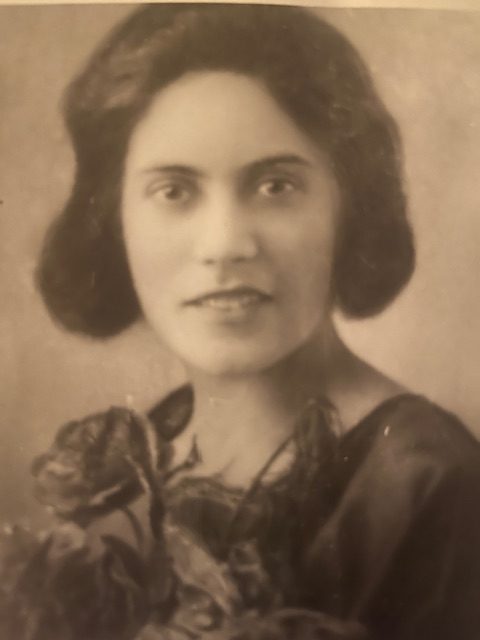
Knowing and understanding the events that shaped your parents and grandparents lives can be invaluable in helping you understand your own story.
Join me at the Italian Historical Society , 199 Faraday St, Carlton, Victoria, 24 June, 6.30 -8.30pm for a discussion about how researching my family history informed and and enriched my memoir – and how it can do the same for yours.


‘Cafarella – that’s Italian, isn’t it?
This was the question everyone asked when I told them my name when I was growing up.
‘Yes,’ I’d say. But it felt like a lie
I had the name and the nose and my father’s olive skin, and that’s all.
Unlike my cousins on Dad’s side of the family, my older sister Julie and I didn’t speak or understand dialect. I didn’t even know it was dialect.
Nor were we Catholic. We were raised Anglican, like my mother’s family.
And while our cousins called our Italian grandparents ‘Nonno’ and ‘Nonna’ , to us they were ‘Nana Cafarella’ and ‘Old Cafarella’, as my mother dubbed our grandfather Gaetano.
We spent much more time with our maternal grandmother, who (affectionately) called me ‘Darkie’.
Even our address in Remo St, Mentone, in Victoria, felt like a lie.
Named after Menton, on the French Rivieria, near the Italian border, its founding fathers had named most streets after Italian towns and cities in the hope of creating a similar seaside resort.
‘Married out’
Unlike most Italians, who stuck together, my father had been keen to shed his Italian identity, and so had “married out’, as it was called then. My mother, with her pale freckly skin and green eyes, was of Irish, Scottish and Danish origin
The marriage was a mistake, as she often reminded us.
Although we all lived under the same roof, in the marital war that followed, my father claimed my sister Julie, while my mother claimed me, further aligning me with my mother’s side of the family.
I was 17 when my parents finally divorced, making the emotional separation physical.
Six months later, an explosive discovery blew my mother and me away from the rest of the family for decades. I didn’t see my sister for 20 years and my cousins for 40 years.
I was in my 50s, when I finally learned my family immigration story from his younger sisters Tess and Tina.
I’d heard part of it directly from my grandmother, Angelina, when as a young journalist, I’d interviewed her. But I was young and ignorant then and wasn’t asking the right questions, and her English wasn’t fluent.
Tess and Tina filled in the details.
First Italian diaspora
From them, I learned that Angelina’s father, Francesco Taranto, had migrated to Massachusetts in the USA in 1901, from his home on Salina, the second largest of the Aeolian Islands, off the coast of Sicily, as part of the first Italian diaspora (1901-1915).
There, he’d married the 16-year-old Maria Carmine Favalora, and my grandmother Angelina was born in Boston in 1903.
When Angelina was just 13 months old, Marie Carmine died tragically after a jealous woman cast the Evil Eye (malocchio) on her after hearing her sing at a party.
While Francesco went to Australia to work, Angelina was sent back to Salina to be cared for by an aunt, whom Francesco later married.
Her aunt and then stepmother, Orsola, was of course, wicked, and refused Francesco’s pleas to join him in Australia.
Angelina was almost 20 when it was finally agreed that he should return to Salina to bring her back to Australia to live with him.
New restrictions in the USA on immigrants from Southern Europe had prevented them from returning to Boston. They were also inspired by ‘paesani’ from the village who had migrated to Australia.
Angelina and her father arrived in Sydney on the Orvieto, an English ship, in May 1923.
Gaetano Cafarella, the man she would later marry, arrived three years later in Australia in 1926, after running away from the Gibilmanna Sanctuary in Palermo, where he was training to be a priest.
Still, there were questions. Why, for example, hadn’t Maria Carmine’s family cared for the young Angelina in Boston? Why was she sent back to Italy? And how had Gaetano come to be interned during World War Two?
Keen to find out more, one day in 2016 I walked into the Italian Historical Society in Faraday St, Carlton.
There, unbelievably, with the help of Paolo Baracchi, Manager of Cultural Events, I discovered a translation of an interview with my grandmother Angelina by researcher Marie Tence.
I’d walked past the society the for years, unaware that the answers to many of my questions were awaiting me there.
The document gave my grandmother a voice I didn’t recognise. Here, she was speaking and thinking in her own language, fluent and insightful: not the broken English of my childhood.
St Lorenzo
Until then, I’d had no idea of her life before her arrival in Australia, and how she’d felt later as a wife and mother in a strange land.
I hadn’t known that she had been engaged to another man before she met my grandfather Gaetano – and that neither was her true love. Her father had insisted that she marry Gaetano, as he was from the same village and known to the family.
‘To tell you the truth, I wasn’t really in love with any of them, because I was very much in love with a young man whom I’ll never forget as long as I live, ‘ she told the interviewer. ‘Isn’t it stupid speaking like this at my age – 80 years old, too!’
While my memoir, CLEAVED, is about family estrangement and growing up with Milroy’s Disease, a form of lymphoedema, it’s also an immigrant story, revealing the effect of that immigration on my grandparents and subsequent generations.
Understanding my Italian family’s immigration story, changed my understanding of my own story.
If you live in Melbourne and are interested in family history and memoir writing, you are warmly invited to join me on June 24 at the Society where I’ll be discussing what I discovered from this document, and how this informed my memoir CLEAVED.
Book here: https://www.coasit.com.au/events/events-archive/1073-book-presentation-cleaved-by-jane-cafarella
